

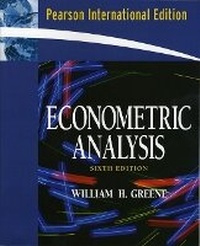
Econometric Analysis
International Edition
6th Edition
Published on 8. January 2008
Book
Paperback/Softback
1216 pages
978-0-13-513740-6 (ISBN)
Description
For first year graduate courses in econometrics for social scientists.
Greene, 6e serves as a bridge between an introduction to the field of econometrics and the professional literature for graduate students in the social sciences, focusing on applied econometrics and theoretical concepts.
Greene, 6e serves as a bridge between an introduction to the field of econometrics and the professional literature for graduate students in the social sciences, focusing on applied econometrics and theoretical concepts.
More details
Edition
6th edition
Language
English
Place of publication
United States
Publishing group
Pearson Education (US)
Target group
Professional and scholarly
Dimensions
Height: 234 mm
Width: 188 mm
Thickness: 42 mm
Weight
1660 gr
ISBN-13
978-0-13-513740-6 (9780135137406)
Copyright in bibliographic data and cover images is held by Nielsen Book Services Limited or by the publishers or by their respective licensors: all rights reserved.
Schweitzer Classification
Other editions
New editions
William Greene | William H. Greene
Econometric Analysis, Global Edition
Book
01/2020
8th Edition
Pearson Education Limited
€82.38
Shipment within 10-20 days
William Greene
Econometric Analysis: International Edition
Book
03/2011
7th Edition
Pearson Education Limited
€74.27
Article exhausted; check for reprint
Previous edition
Book
09/2002
5th Edition
Pearson
€64.36
Article exhausted; check for reprint
Content
Preface
Chapter 1 - Introduction
Chapter 2 - The Classical Multiple Linear Regression Model
Chapter 3 - Least Squares
Chapter 4 - Statistical Properties of the Least Squares Estimator
Chapter 5 - Inference and Prediction
Chapter 6 - Functional Form and Structural Change
Chapter 7 - Specification Analysis and Model Selection
Chapter 8 - Generalized Regression Model and Heteroscedasticity
Chapter 9 - Models for Panel Data
Chapter 10 -Systems of Regression Equations
Chapter 11 - Nonlinear Regression Models
Chapter 12 - Instrumental Variables Estimation
Chapter 13 - Simultaneous-Equations Model
Chapter 14 - Estimation Frameworks in Econometrics
Chapter 15 - Minimum Distance Estimation and the Generalized Method of Moments
Chapter 16 - Maximum Likelihood Estimation
Chapter 17 - Simulation Based Estimation and Inference
Chapter 18 - Bayesian Estimation and Inference
Chapter 19 - Serial Correlation
Chapter 20 - Models With Lagged Variables
Chapter 21 - Time-Series Models
Chapter 22 - Nonstationary Data
Chapter 23 - Models for Discrete Choice
Chapter 24 - Truncation, Censoring and Sample Selection
Chapter 25 - Models for Event Counts and Duration
Appendix A: Matrix Algebra
Appendix B: Probability and Distribution Theory
Appendix C: Estimation and Inference
Appendix D: Large Sample Distribution Theory
Appendix E: Computation and Optimization
Appendix F: Data Sets Used in Applications
Appendix G: Statistical Tables
References
Author Index
Subject Index
Chapter 1 - Introduction
Chapter 2 - The Classical Multiple Linear Regression Model
Chapter 3 - Least Squares
Chapter 4 - Statistical Properties of the Least Squares Estimator
Chapter 5 - Inference and Prediction
Chapter 6 - Functional Form and Structural Change
Chapter 7 - Specification Analysis and Model Selection
Chapter 8 - Generalized Regression Model and Heteroscedasticity
Chapter 9 - Models for Panel Data
Chapter 10 -Systems of Regression Equations
Chapter 11 - Nonlinear Regression Models
Chapter 12 - Instrumental Variables Estimation
Chapter 13 - Simultaneous-Equations Model
Chapter 14 - Estimation Frameworks in Econometrics
Chapter 15 - Minimum Distance Estimation and the Generalized Method of Moments
Chapter 16 - Maximum Likelihood Estimation
Chapter 17 - Simulation Based Estimation and Inference
Chapter 18 - Bayesian Estimation and Inference
Chapter 19 - Serial Correlation
Chapter 20 - Models With Lagged Variables
Chapter 21 - Time-Series Models
Chapter 22 - Nonstationary Data
Chapter 23 - Models for Discrete Choice
Chapter 24 - Truncation, Censoring and Sample Selection
Chapter 25 - Models for Event Counts and Duration
Appendix A: Matrix Algebra
Appendix B: Probability and Distribution Theory
Appendix C: Estimation and Inference
Appendix D: Large Sample Distribution Theory
Appendix E: Computation and Optimization
Appendix F: Data Sets Used in Applications
Appendix G: Statistical Tables
References
Author Index
Subject Index