

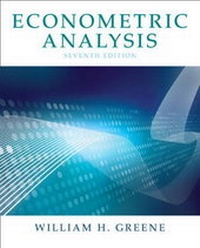
Econometric Analysis
7th Edition
Published on 2. February 2011
Book
Hardback
1232 pages
978-0-13-139538-1 (ISBN)
Description
Econometric Analysis serves as a bridge between an introduction to the field of econometrics and the professional literature for social scientists and other professionals in the field of social sciences, focusing on applied econometrics and theoretical background. This book provides a broad survey of the field of econometrics that allows the reader to move from here to practice in one or more specialized areas. At the same time, the reader will gain an appreciation of the common foundation of all the fields presented and use the tools they employ.
More details
Edition
7th edition
Language
English
Place of publication
United States
Publishing group
Pearson Education (US)
Target group
College/higher education
Dimensions
Height: 10 mm
Width: 10 mm
Thickness: 10 mm
Weight
1700 gr
ISBN-13
978-0-13-139538-1 (9780131395381)
Copyright in bibliographic data and cover images is held by Nielsen Book Services Limited or by the publishers or by their respective licensors: all rights reserved.
Schweitzer Classification
Other editions
Previous edition
William H. Greene
Econometric Analysis
Book
09/2007
6th Edition
Prentice Hall
€131.21
Article exhausted; check for reprint
Content
Part I: The Linear Regression Model
Chapter 1: Econometrics
Chapter 2: The Linear Regression Model
Chapter 3: Least Squares
Chapter 4: The Least Squares Estimator
Chapter 5: Hypothesis Tests and Model Selection
Chapter 6: Functional Form and Structural Change
Chapter 7: Nonlinear, Semiparametric, and Nonparametric Regression Models
Chapter 8: Endogeneity and Instrumental Variable Estimation
Part II: Generalized Regression Model and Equation Systems
Chapter 9: The Generalized Regression Model and Heteroscedasticity
Chapter 10: Systems of Equations
Chapter 11: Models for Panel Data
Part III: Estimation Methodology
Chapter 12: Estimation Frameworks in Econometrics
Chapter 13: Minimum Distance Estimation and the Generalized Method of Moments
Chapter 14: Maximum Likelihood Estimation
Chapter 15: Simulation-Based Estimation and Inference
Chapter 16: Bayesian Estimation and Inference
Part IV: Cross Sections, Panel Data, and Microeconometrics
Chapter 17: Discrete Choice
Chapter 18: Discrete Choices and Event Counts
Chapter 19: Limited Dependent Variables-Truncation, Censoring, and Sample Selection
Part V: Time Series and Macroeconometrics
Chapter 20: Serial Correlation
Chapter 21: Models with Lagged Variables
Chapter 22: Time-Series Models
Chapter 23: Nonstationary Data
Part VI: Appendices
Appendix A: Matrix Algebra
Appendix B: Probability and Distribution Theory
Appendix C: Estimation and Inference
Appendix D: Large-Sample Distribution Theory
Appendix E: Computation and Optimization
Appendix F: Data Sets Used in Applications
Appendix G: Statistical Tables
Chapter 1: Econometrics
Chapter 2: The Linear Regression Model
Chapter 3: Least Squares
Chapter 4: The Least Squares Estimator
Chapter 5: Hypothesis Tests and Model Selection
Chapter 6: Functional Form and Structural Change
Chapter 7: Nonlinear, Semiparametric, and Nonparametric Regression Models
Chapter 8: Endogeneity and Instrumental Variable Estimation
Part II: Generalized Regression Model and Equation Systems
Chapter 9: The Generalized Regression Model and Heteroscedasticity
Chapter 10: Systems of Equations
Chapter 11: Models for Panel Data
Part III: Estimation Methodology
Chapter 12: Estimation Frameworks in Econometrics
Chapter 13: Minimum Distance Estimation and the Generalized Method of Moments
Chapter 14: Maximum Likelihood Estimation
Chapter 15: Simulation-Based Estimation and Inference
Chapter 16: Bayesian Estimation and Inference
Part IV: Cross Sections, Panel Data, and Microeconometrics
Chapter 17: Discrete Choice
Chapter 18: Discrete Choices and Event Counts
Chapter 19: Limited Dependent Variables-Truncation, Censoring, and Sample Selection
Part V: Time Series and Macroeconometrics
Chapter 20: Serial Correlation
Chapter 21: Models with Lagged Variables
Chapter 22: Time-Series Models
Chapter 23: Nonstationary Data
Part VI: Appendices
Appendix A: Matrix Algebra
Appendix B: Probability and Distribution Theory
Appendix C: Estimation and Inference
Appendix D: Large-Sample Distribution Theory
Appendix E: Computation and Optimization
Appendix F: Data Sets Used in Applications
Appendix G: Statistical Tables