

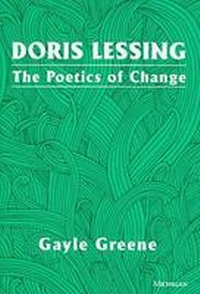
Doris Lessing
The Poetics of Change
Published on 21. August 1997
Book
Paperback/Softback
296 pages
978-0-472-08433-3 (ISBN)
Description
Doris Lessing has been a chronicler of our age for nearly half a century, and a study of her writing career does not yield easy generalizations. Difficult though she is to categorize, she is always concerned with change, with a search for "something new" against "the nightmare repetition" of history. The feminist quest she articulated in The Children of Violence and The Golden Notebook entered the culture with the force of a new myth: these books changed lives. The Golden Notebook--together with such works as The Second Sex and The Feminine Mystique--raised the consciousness of a generation of women readers and played a major part in making the second wave of feminism. It is the power of Lessing's novels to change people's lives, the effect she had raising the consciousness of a generation of women and the effect she continues to have on young readers, that is the subject of this book.
Gayle Greene employs an eclectic range of approaches (psychoanalytic, Marxist, biographical, historical, intertextual, formalist, feminist) to shed new light on Lessing's remarkable achievement. She sees Lessing as a feminist writer, not in offering strong female role models who climb top the top of existing social structures, but in envisioning, and indeed helping to bring about, a transformation of those structures. Lessing critiques Western values of individualism, competition, and materialism in terms similar to those developed by feminism; and, in getting us to view our culture from without, in teaching us to read cultural constructs as systems, her novels perform the deconstructing and demystifying work of feminism.
Gayle Greene employs an eclectic range of approaches (psychoanalytic, Marxist, biographical, historical, intertextual, formalist, feminist) to shed new light on Lessing's remarkable achievement. She sees Lessing as a feminist writer, not in offering strong female role models who climb top the top of existing social structures, but in envisioning, and indeed helping to bring about, a transformation of those structures. Lessing critiques Western values of individualism, competition, and materialism in terms similar to those developed by feminism; and, in getting us to view our culture from without, in teaching us to read cultural constructs as systems, her novels perform the deconstructing and demystifying work of feminism.
Reviews / Votes
"This highly recommended book, which is certain to have a major impact on Lessing studies, should be owned by all academic libraries."--Choice * Choice * "Most books that treat of atomic catastrophe are a hard sell, the reason being, of course, that scarcely anybody can bear to read them. But The Woman Who Knew Too Much is something of an exception. . . . A book that unflinchingly describes the contemporary human situation."
--Anna Mayo, The Texas Observer, August 2001 -- Anna Mayo * The Texas Observer *
More details
Language
English
Place of publication
Ann Arbor
United States
Target group
Professional and scholarly
Dimensions
Height: 229 mm
Width: 152 mm
ISBN-13
978-0-472-08433-3 (9780472084333)
Copyright in bibliographic data and cover images is held by Nielsen Book Services Limited or by the publishers or by their respective licensors: all rights reserved.
Schweitzer Classification
Person
Doris Lessing is a readable yet theoretically informed study of this vastly complex and important writer that attempts to account for her wide and lasting appeal and that hopes to reach many of the readers Lessing herself reaches.
Gayle Greene is Professor of English and Women's Studies, Scripps College. She is the author of Changing the Story: Feminist Fiction and the Tradition, and coeditor, with Coppelia Kahn, of Changing Subjects: The Making of Feminist Criticism.
Gayle Greene is Professor of English and Women's Studies, Scripps College. She is the author of Changing the Story: Feminist Fiction and the Tradition, and coeditor, with Coppelia Kahn, of Changing Subjects: The Making of Feminist Criticism.