

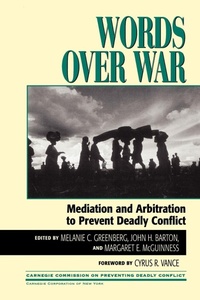
Words Over War
Mediation and Arbitration to Prevent Deadly Conflict
Published on 12. January 2000
Book
Paperback/Softback
499 pages
978-0-8476-9893-6 (ISBN)
Description
The international community can creatively and aggressively address deadly conflict through mediation, arbitration, and the development of international institutions to promote reconciliation. The editors of this book designed a systematic framework with which contributors compare third party intervention in twelve conflicts of the postDCold War period. They examine the role of international organizations_the United Nations, international development banks, and international law institutions_and they analyze the tools and forms of leverage in successful and unsuccessful mediations. Based on the case studies, the editors identify the most effective institutions, make recommendations for improving interventions, and elucidate several important insights into the mediation process and the role of the international community in dispute resolution.
Reviews / Votes
Words over War is part of the important series of books and reports sponsored by the Carnegie Commission on Preventing Deadly Conflict. The book is a welcome addition to the study of conflict prevention and dispute resolution. * The American Journal Of International Law * The case studies in this volume discuss at length the changing international arena and the role of the international community in mediating deadly conflict. The studies represent a fascinating cross section of conflict in the post-Cold War era. . . . Only by studying different forms of mediation, and at the same time by comparing controlled variables, can we begin to understand how to make mediation more effective and how to use it in our arsenal of tools for preventing deadly conflict. . . . I sincerely hope that this volume will inspire future mediators in their search for peace and reconciliation. -- Cyrus R. Vance Jr., from the forewordMore details
Series
Language
English
Place of publication
United States
Publishing group
Bloomsbury Publishing Plc
Target group
College/higher education
Professional and scholarly
Dimensions
Height: 229 mm
Width: 152 mm
Thickness: 28 mm
Weight
782 gr
ISBN-13
978-0-8476-9893-6 (9780847698936)
Copyright in bibliographic data and cover images is held by Nielsen Book Services Limited or by the publishers or by their respective licensors: all rights reserved.
Schweitzer Classification
Other editions
Additional editions
Words Over War
Mediation and Arbitration to Prevent Deadly Conflict
E-Book
01/2000
1st Edition
Rowman & Littlefield Publishers
€55.99
Available for download
Melanie Greenberg | John H. Barton | Margaret E. McGuinness
Words Over War
Mediation and Arbitration to Prevent Deadly Conflict
E-Book
01/2000
Bloomsbury eBooks US
€55.99
Available for download
Persons
Melanie Greenberg is an adjunct professor at Georgetown Law Center and a lecturer-at-law at Stanford Law School. She has served as the associate director of the Stanford Center on International Security and Cooperation, and deputy director of the Stanford Center on Conflict and Negotiation. John H. Barton is George E. Osborne Professor of Law at the Stanford Law School and co-director of the Stanford Law and Technology Policy Center. He has authored or co-authored several volumes on arms control issues. Margaret E. McGuinness is completing her JD at Stanford Law School. She served in the United States Foreign Service from 1988 to 1996. Her overseas postings included Canada, Pakistan, and Germany. She served as a Special Assistant to Secretary of State Warren Christopher from 1993 to 1994.
Content
Chapter 1 Introduction: Background and Analytical Perspectives
Part 2 Part One: Separation of Nations
Chapter 3 Multilateral Mediation in Intrastate Conflicts: Russia, the United Nations, and the War in Abkhazia
Chapter 4 From Lisbon to Dayton: International Mediation and the Bosnia Crisis
Chapter 5 Croatian Independence from Yugoslavia, 1991-1992
Chapter 6 The Oslo Channel: Benefits of a Neutral Facilitator to Secret Negotiations
Part 7 Part Two: Integration of Nations
Chapter 8 The 1991 Cambodia Settlement Agreements
Chapter 9 El Salvador
Chapter 10 The Role of Mediation in the Northern Ireland Peace Process
Chapter 11 The Arusha Accords and the Failure of International Intervention in Rwanda
Chapter 12 South Africa: The Negotiated Transition from Apartheid to Nonracial Democracy
Part 13 Part Three: Intermediation in Noncivil Conflicts
Chapter 14 Making Waves: Third Parties and International Mediation in the Aral Sea Basin
Chapter 15 The Vatican Mediation of the Beagle Channel Dispute: Crisis Intervention and Forum-Building
Chapter 16 The North Korean Nuclear Proliferation Crisis
Part 17 Part Four: Conclusion
Chapter 18 Lessons of the Case Studies for International Mediation and Arbitration to Prevent Deadly Conflict
Part 2 Part One: Separation of Nations
Chapter 3 Multilateral Mediation in Intrastate Conflicts: Russia, the United Nations, and the War in Abkhazia
Chapter 4 From Lisbon to Dayton: International Mediation and the Bosnia Crisis
Chapter 5 Croatian Independence from Yugoslavia, 1991-1992
Chapter 6 The Oslo Channel: Benefits of a Neutral Facilitator to Secret Negotiations
Part 7 Part Two: Integration of Nations
Chapter 8 The 1991 Cambodia Settlement Agreements
Chapter 9 El Salvador
Chapter 10 The Role of Mediation in the Northern Ireland Peace Process
Chapter 11 The Arusha Accords and the Failure of International Intervention in Rwanda
Chapter 12 South Africa: The Negotiated Transition from Apartheid to Nonracial Democracy
Part 13 Part Three: Intermediation in Noncivil Conflicts
Chapter 14 Making Waves: Third Parties and International Mediation in the Aral Sea Basin
Chapter 15 The Vatican Mediation of the Beagle Channel Dispute: Crisis Intervention and Forum-Building
Chapter 16 The North Korean Nuclear Proliferation Crisis
Part 17 Part Four: Conclusion
Chapter 18 Lessons of the Case Studies for International Mediation and Arbitration to Prevent Deadly Conflict