

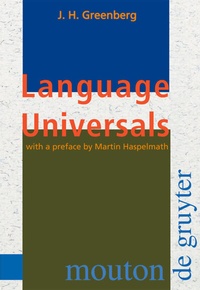
Language Universals
With Special Reference to Feature Hierarchies
1st Edition
Published on 18. July 2005
Book
Hardback
XVII, 89 pages
978-3-11-017284-3 (ISBN)
Description
"This is the latest version of the 1956 book which began the modern study of universals, and provides the foundation for many inquiries that followed. The hypotheses are cast at a moderate level of abstraction, and so are likely to survive as a basis for inquiry for many decades to come."
Prof. Dr. William Labov
Prof. Dr. William Labov
More details
Edition
Reprint 2010
Language
English
Place of publication
Berlin/Boston
Germany
Publishing group
de Gruyter Mouton
Target group
Professional and scholarly
US School Grade: College Graduate Student
Dimensions
Height: 236 mm
Width: 160 mm
Thickness: 14 mm
Weight
349 gr
ISBN-13
978-3-11-017284-3 (9783110172843)
Schweitzer Classification
Other editions
Additional editions
E-Book
12/2010
1st Edition
De Gruyter Mouton
€119.95
Available for download
Persons
"Joseph H. Greenberg was one of the most original and influential linguists of the twentieth century. He died at his home in Stanford, California, in May 2001. Joseph H. Greenberg was a major pioneer in the
development of linguistics as an empirical science. His work was always founded directly on quantitative data from a single language or from a wide range of languages. His chief legacy to contemporary linguistics is in the development of an approach to the study of language - typology and univerals - and to historical linguistics. Yet he also made major contributions to sociolinguistics, psycholinguistics, phonetics and phonology, morphology, and especially African language studies." From an obituary by William Croft, University of Manchester, England.
Martin Haspelmath is Professor of Linguistics at the Max Planck Institute for Evolutionary Anthropology,
Department of Linguistics, Leipzig, Germany.
Content
Martin Haspelmath: Introduction to second edition
Preface
1. Introduction: Marked and unmarked categories
2. Phonology
3. Grammar and Lexicon
4. Common characteristics in phonology, grammar, and lexicon
5. Universals of kinship terminology
References
Preface
1. Introduction: Marked and unmarked categories
2. Phonology
3. Grammar and Lexicon
4. Common characteristics in phonology, grammar, and lexicon
5. Universals of kinship terminology
References