

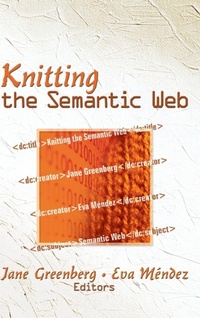
Knitting the Semantic Web
1st Edition
Published on 9. August 2007
Book
Hardback
284 pages
978-0-7890-3591-2 (ISBN)
Description
The Semantic Web, extends the popular, day-to-day Web, enabling computers and people to effectively work together by giving information well-defined meaning. Knitting the Semantic Web explains the interdisciplinary efforts underway to build a more library-like Web through "semantic knitting." The book examines foundation activities and initiatives leading to standardized semantic metadata. These efforts lead to the Semantic Web-a network able to support computational activities and provide people with services efficiently. Leaders in library and information science, computer science, and information intensive domains provide insight and inspiration to give readers a greater understanding of the evolution of the Semantic Web.
Librarians and information professionals are uniquely qualified to play a major role in the development and maintenance of the Semantic Web. Knitting the Semantic Web closely examines this crucial relationship in detail. This single source reviews the foundations, standards, and tools underlying the Semantic Web and presents thoughtful perspectives in the context of 2.0 developments. Many chapters include figures to illustrate concepts and ideas, and the entire text is extensively referenced.
Topics in Knitting the Semantic Web include:
RDF, its expressive power, and its ability to underlie the new Library catalog card for the coming century
the value and application for controlled vocabularies
SKOS (Simple Knowledge Organization System), the newest Semantic Web language
managing scheme versioning in the Semantic Web
Physnet portal service for physics
Semantic Web technologies in biomedicine
developing the United Nations Food and Agriculture ontology
Friend Of A Friend (FOAF) vocabulary specification-with a real world case study at a university
Web/Library 2.0
and more
Knitting the Semantic Web is a stimulating resource for professionals, researchers, educators, and students in library and information science, computer science, information architecture, Web design, and Web services.
Librarians and information professionals are uniquely qualified to play a major role in the development and maintenance of the Semantic Web. Knitting the Semantic Web closely examines this crucial relationship in detail. This single source reviews the foundations, standards, and tools underlying the Semantic Web and presents thoughtful perspectives in the context of 2.0 developments. Many chapters include figures to illustrate concepts and ideas, and the entire text is extensively referenced.
Topics in Knitting the Semantic Web include:
RDF, its expressive power, and its ability to underlie the new Library catalog card for the coming century
the value and application for controlled vocabularies
SKOS (Simple Knowledge Organization System), the newest Semantic Web language
managing scheme versioning in the Semantic Web
Physnet portal service for physics
Semantic Web technologies in biomedicine
developing the United Nations Food and Agriculture ontology
Friend Of A Friend (FOAF) vocabulary specification-with a real world case study at a university
Web/Library 2.0
and more
Knitting the Semantic Web is a stimulating resource for professionals, researchers, educators, and students in library and information science, computer science, information architecture, Web design, and Web services.
More details
Language
English
Place of publication
New York
United States
Publishing group
Taylor & Francis Inc
Target group
College/higher education
Dimensions
Height: 235 mm
Width: 157 mm
Thickness: 20 mm
Weight
566 gr
ISBN-13
978-0-7890-3591-2 (9780789035912)
Copyright in bibliographic data and cover images is held by Nielsen Book Services Limited or by the publishers or by their respective licensors: all rights reserved.
Schweitzer Classification
Other editions
Additional editions
Jane Greenberg | Eva Mendez Rodriguez
Knitting the Semantic Web
E-Book
04/2013
1st Edition
Routledge
€67.49
Available for download
Jane Greenberg | Eva Mendez Rodriguez
Knitting the Semantic Web
E-Book
04/2013
1st Edition
Routledge
€67.49
Available for download
Jane Greenberg | Eva Mendez Rodriguez
Knitting the Semantic Web
Book
08/2012
1st Edition
Routledge
€73.60
Shipment within 15-20 days
Persons
Jane Greenberg, PhD, MS, is Associate Professor at the School of Information and Library Science, University of North Carolina at Chapel Hill, Director of the SILS Metadata Research Center, and was recently awarded a Frances Carroll McColl Professorship. She is the Principal Investigator of the Memex Metadata (M2) for Student Portfolios project. She is a member of the Dublin Core Metadata Initiative (DCMI) Advisory Board and a co-chair of the DCMI Tools Working Group. She regularly serves on national and international digital information and metadata conference program committees, and was program co-chair of the Dublin Core 2003 conference. Dr. Greenberg was the Principal Investigator of the AMeGA (Automatic Metadata Generation Applications) project and the Metadata Generation Research (MGR), collectively sponsored by Microsoft Research, OCLC Online Computer Center, and the Library of Congress.
Eva Mendez Rodriguez, PhD, is Associate Professor at the University Carlos III of Madrid, where she has been teaching and conducting research since March 1997. She is a member of the Dublin Core Metadata Initiative (DCMI) Advisory Board, and served as co-chair of the International Conference on Dublin Core and Metadata Applications (Vocabularies in Practice) held in Madrid in 2005. Her research focuses on Semantic Web technologies applied to digital information systems and services, with an emphasis on metadata standards and vocabularies. In addition to the DCMI, Dr. Mendez has served on many conference and workshop program committees worldwide. She has also served as an advisor on information practice and policy for countries in the European Union and Latin America. Dr. Mendez was Fulbright-EU Research Scholar at University of North Carolina at Chapel Hill, School of Information and Library Science, Metadata Research Center, during the academic year 2005-2006.
Eva Mendez Rodriguez, PhD, is Associate Professor at the University Carlos III of Madrid, where she has been teaching and conducting research since March 1997. She is a member of the Dublin Core Metadata Initiative (DCMI) Advisory Board, and served as co-chair of the International Conference on Dublin Core and Metadata Applications (Vocabularies in Practice) held in Madrid in 2005. Her research focuses on Semantic Web technologies applied to digital information systems and services, with an emphasis on metadata standards and vocabularies. In addition to the DCMI, Dr. Mendez has served on many conference and workshop program committees worldwide. She has also served as an advisor on information practice and policy for countries in the European Union and Latin America. Dr. Mendez was Fulbright-EU Research Scholar at University of North Carolina at Chapel Hill, School of Information and Library Science, Metadata Research Center, during the academic year 2005-2006.
Content
About the Authors
Introduction: Toward a More Library-Like Web via Semantic Knitting (Jane Greenberg and Eva Mendez)
PART I: SEMANTIC WEB FOUNDATIONS, STANDARDS, AND TOOLS
The Birth of the New Web: A Foucauldian Reading of the Semantic Web (D. Grant Campbell)
Library Cards for the 21st Century (Charles McCathieNevile and Eva Mendez)
Library of Congress Controlled Vocabularies and Their Application to the Semantic Web (Corey A. Harper and Barbara B. Tillett)
SKOS: Simple Knowledge Organisation for the Web (Alistair Miles and Jose R. Perez-Agueera)
Scheme Versioning in the Semantic Web (Joseph T. Tennis)
Roles for Semantic Technologies and Tools in Libraries (G. Philip Rogers)
PART II: SEMANTIC WEB PROJECTS AND PERSPECTIVES
RDF Database for PhysNet and Similar Portals (Thomas Severiens and Christian Thiemann)
Biomedicine and the Semantic Web: A Knowledge Model for Visual Phenotype (John Michon)
Towards an Infrastructure for Semantic Applications: Methodologies for Semantic Integration of Heterogeneous Resources (Anita C. Liang, Gauri Salokhe, Margherita Sini, and Johannes Keizer)
FOAF: Connecting People on the Semantic Web (Mike Graves, Adam Constabaris, and Dan Brickley)
Advancing the Semantic Web via Library Functions (Jane Greenberg)
Social Bibliography: A Personal Perspective on Libraries and the Semantic Web (Stuart L. Weibel)
Index
Reference Notes Included
Introduction: Toward a More Library-Like Web via Semantic Knitting (Jane Greenberg and Eva Mendez)
PART I: SEMANTIC WEB FOUNDATIONS, STANDARDS, AND TOOLS
The Birth of the New Web: A Foucauldian Reading of the Semantic Web (D. Grant Campbell)
Library Cards for the 21st Century (Charles McCathieNevile and Eva Mendez)
Library of Congress Controlled Vocabularies and Their Application to the Semantic Web (Corey A. Harper and Barbara B. Tillett)
SKOS: Simple Knowledge Organisation for the Web (Alistair Miles and Jose R. Perez-Agueera)
Scheme Versioning in the Semantic Web (Joseph T. Tennis)
Roles for Semantic Technologies and Tools in Libraries (G. Philip Rogers)
PART II: SEMANTIC WEB PROJECTS AND PERSPECTIVES
RDF Database for PhysNet and Similar Portals (Thomas Severiens and Christian Thiemann)
Biomedicine and the Semantic Web: A Knowledge Model for Visual Phenotype (John Michon)
Towards an Infrastructure for Semantic Applications: Methodologies for Semantic Integration of Heterogeneous Resources (Anita C. Liang, Gauri Salokhe, Margherita Sini, and Johannes Keizer)
FOAF: Connecting People on the Semantic Web (Mike Graves, Adam Constabaris, and Dan Brickley)
Advancing the Semantic Web via Library Functions (Jane Greenberg)
Social Bibliography: A Personal Perspective on Libraries and the Semantic Web (Stuart L. Weibel)
Index
Reference Notes Included