

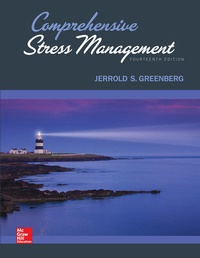
Comprehensive Stress Management
14th Edition
Published on 16. August 2016
Book
Paperback/Softback
480 pages
978-0-07-802866-3 (ISBN)
Description
Greenberg's Comprehensive Stress Management integrates research and theories found useful when dealing with the inevitable occurrence of stress, with an emphasis on the interrelation of stress and illness. The 14th edition provides up-to-date information on stress associated with college student debts and technology use, as well as a new perspective on religion and spirituality as it relates to stress. The Connect course for this offering includes SmartBook, an adaptive reading and study experience which guides students to master, recall, and applies key concepts while providing automatically-graded assessment. This technology empowers students to learn what stress is, evaluate their level of stress, and apply to their own lives the tools and skills necessary to manage stress.
Instructors and students can now access their course content through the Connect digital learning platform by purchasing either standalone Connect access or a bundle of print and Connect access. McGraw-Hill Connect (R) is a subscription-based learning service accessible online through your personal computer or tablet. Choose this option if your instructor will require Connect to be used in the course. Your subscription to Connect includes the following:
* SmartBook (R) - an adaptive digital version of the course textbook that personalizes your reading experience based on how well you are learning the content.
* Access to your instructor's homework assignments, quizzes, syllabus, notes, reminders, and other important files for the course.
* Progress dashboards that quickly show how you are performing on your assignments and tips for improvement.
* The option to purchase (for a small fee) a print version of the book. This binder-ready, loose-leaf version includes free shipping.
Complete system requirements to use Connect can be found here: http://www.mheducation.com/highered/platforms/connect/training-support-students.html
Instructors and students can now access their course content through the Connect digital learning platform by purchasing either standalone Connect access or a bundle of print and Connect access. McGraw-Hill Connect (R) is a subscription-based learning service accessible online through your personal computer or tablet. Choose this option if your instructor will require Connect to be used in the course. Your subscription to Connect includes the following:
* SmartBook (R) - an adaptive digital version of the course textbook that personalizes your reading experience based on how well you are learning the content.
* Access to your instructor's homework assignments, quizzes, syllabus, notes, reminders, and other important files for the course.
* Progress dashboards that quickly show how you are performing on your assignments and tips for improvement.
* The option to purchase (for a small fee) a print version of the book. This binder-ready, loose-leaf version includes free shipping.
Complete system requirements to use Connect can be found here: http://www.mheducation.com/highered/platforms/connect/training-support-students.html
More details
Edition
14th edition
Language
English
Place of publication
New York
United States
Publishing group
McGraw-Hill Education - Europe
Target group
College/higher education
US School Grade: College Freshman
Illustrations
70 Illustrations
Dimensions
Height: 272 mm
Width: 216 mm
Thickness: 18 mm
Weight
853 gr
ISBN-13
978-0-07-802866-3 (9780078028663)
Schweitzer Classification
Other editions
Previous edition
Jerrold S. Greenberg
Comprehensive Stress Management
Book
09/2012
13th Edition
McGraw-Hill Inc.,US
€195.95
No shipping information available
Person
Professor in the Department of Public and Community Health at the University of Maryland. Dr. Greenberg earned his baccalaureate and masters degrees from The City College of New York, and then continued his education at Syracuse University where he earned his doctorate. Dr. Greenberg taught at Syracuse University, Boston University, and the State University of New York at Buffalo before accepting his current position at the University of Maryland in 1979. Dr. Greenberg has written over 50 books on such topics as elder care, health, stress management, physical fitness, sexuality, and methods of health education. In addition, he has published over 80 articles in professional journals and lay magazines. Among Dr. Greenberg's honors are included: the University of Maryland Service-Learning Advocate of Year Award for 2003-2004; the American School Health Association's Distinguished Service Award; selection as Alliance Scholar by the American Alliance for Health, Physical Education, Recreation, and Dance; the Presidential Citation, the Certificate of Appreciation, and the Scholar Award of the American Association for Health Education; selection for inclusion in Who's Who in America, Outstanding Young Men of America, and Who's Who in World Jewry. Dr. Greenberg has also served on the editorial boards of the professional journals Health Education and The Journal of School Health and as a reviewer for other professional journals. In addition, Dr. Greenberg has conducted stress management workshops for professional, business, and lay organizations throughout the United States.
Content
Part 1 Scientific FoundationsChapter 1: What Is Stress?Chapter 2: Stress PsychophysiologyChapter 3: Stress and Illness/DiseaseChapter 4: Stress and the College StudentPart 2 General Applications: Life-Situation and Perception InterventionsChapter 5: Intervention Chapter 6: Life-Situation Interventions: IntrapersonalChapter 7: Life-Situation Interventions: InterpersonalChapter 8: Perception InterventionsChapter 9: Spirituality and StressPart 3 General Applications: Relaxation TechniquesChapter 10: MeditationChapter 11: Autogenic Training, Imagery, and Progressive RelaxationChapter 12: Other Relaxation TechniquesPart 4 General Applications: Physiological Arousal and Behavior Change InterventionsChapter 13: Physiological Arousal InterventionsChapter 14: Strategies for Decreasing Stressful BehaviorsChapter 15: Diversity and StressPart 5 Specific ApplicationsChapter 16: Occupational StressChapter 17: Family Stress