

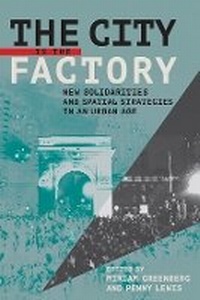
The City Is the Factory
New Solidarities and Spatial Strategies in an Urban Age
Published on 6. June 2017
Book
Hardback
284 pages
978-1-5017-0553-3 (ISBN)
Description
Urban public spaces, from the streets and squares of Buenos Aires to Zuccotti Park in New York City, have become the emblematic sites of contentious politics in the twenty-first century. As the contributors to The City Is the Factory argue, this resurgent politics of the square is itself part of a broader shift in the primary locations and targets of popular protest from the workplace to the city. This shift is due to an array of intersecting developments: the concentration of people, profit, and social inequality in growing urban areas; the attacks on and precarity faced by unions and workers' movements; and the sense of possibility and actual leverage afforded by local politics and the tactical use of urban space. Thus, "the city"-from the town square to the banlieu-is becoming like the factory of old: a site of production and profit-making as well as new forms of solidarity, resistance, and social reimagining.We see examples of the city as factory in new place-based political alliances, as workers and the unemployed find common cause with "right to the city" struggles. Demands for jobs with justice are linked with demands for the urban commons-from affordable housing to a healthy environment, from immigrant rights to "urban citizenship" and the right to streets free from both violence and racially biased policing. The case studies and essays in The City Is the Factory provide descriptions and analysis of the form, substance, limits, and possibilities of these timely struggles.
Contributors
Melissa Checker, Queens College and the Graduate Center of the City University of New York; Daniel Aldana Cohen, University of Pennsylvania; Els de Graauw, Baruch College, City University of New York; Kathleen Dunn, Loyola University Chicago
Shannon Gleeson, Cornell University; Miriam Greenberg, University of California, Santa Cruz; Alejandro Grimson, Universidad de San Martin (Argentina); Andrew Herod, University of Georgia; Penny Lewis, Joseph S. Murphy Institute for Worker Education and Labor Studies, City University of New York; Stephanie Luce, Joseph S. Murphy Institute for Worker Education and Labor Studies, City University of New York; Lize Mogel, artist and coeditor of An Atlas of Radical Cartography; Gretchen Purser, Maxwell School of Citizenship and Public Affairs, Syracuse University
Contributors
Melissa Checker, Queens College and the Graduate Center of the City University of New York; Daniel Aldana Cohen, University of Pennsylvania; Els de Graauw, Baruch College, City University of New York; Kathleen Dunn, Loyola University Chicago
Shannon Gleeson, Cornell University; Miriam Greenberg, University of California, Santa Cruz; Alejandro Grimson, Universidad de San Martin (Argentina); Andrew Herod, University of Georgia; Penny Lewis, Joseph S. Murphy Institute for Worker Education and Labor Studies, City University of New York; Stephanie Luce, Joseph S. Murphy Institute for Worker Education and Labor Studies, City University of New York; Lize Mogel, artist and coeditor of An Atlas of Radical Cartography; Gretchen Purser, Maxwell School of Citizenship and Public Affairs, Syracuse University
Reviews / Votes
"The City Is the Factory brings together and updates the interdisciplinary scholarly research on urban politics, critical geography, neoliberalism, and social and labor movements. The editors and contributors examine and theorize about how contemporary social and labor activists form alliances that respond to neoliberal urban politics in novel ways and how they relate to urban spaces through collective action." -- Ellen Reese, Professor of Sociology and Chair of Labor Studies, University of California, Riverside, author of <I>They Say Cut Back, We Say Fight Back! Welfare Activism in an Era of Retrenchment</I> "This book makes clear the importance of community- or city-based unionism and social movements. The future of organizing is going to have to take into account the centrality of the urban in capital accumulation processes, because it is through such processes that exploitation and oppression often work. The city is now indeed the factory." -- Don Mitchell, Distinguished Professor of Geography, Syracuse University, author of <I>The Right to the City: Social Justice and the Fight for Public Space</I>More details
Language
English
Place of publication
New York
United States
Publishing group
Cornell University Press
Product notice
Paper over boards
Illustrations
- 9 Halftones, black and white
Dimensions
Height: 229 mm
Width: 152 mm
Thickness: 25 mm
Weight
907 gr
ISBN-13
978-1-5017-0553-3 (9781501705533)
Copyright in bibliographic data and cover images is held by Nielsen Book Services Limited or by the publishers or by their respective licensors: all rights reserved.
Schweitzer Classification
Other editions
Additional editions
Miriam Greenberg | Penny Lewis
The City Is the Factory
New Solidarities and Spatial Strategies in an Urban Age
E-Book
06/2017
ILR Press
€28.49
Available for download
Persons
Miriam Greenberg is Professor of Sociology at the University of California, Santa Cruz. She is the author of Branding New York: How a City in Crisis Was Sold to the World and coauthor of Crisis Cities: Disaster and Redevelopment in New York and New Orleans. Penny Lewis is Associate Professor of Labor Studies at the Joseph S. Murphy Institute for Worker Education and Labor Studies, City University of New York. She is the author of Hardhats, Hippies and Hawks: The Vietnam Antiwar Movement as Myth and Memory and coeditor of The City Is the Factory New Solidarities and Spatial Strategies in an Urban Age, both from Cornell.
Content
Introduction: From the Factory to the City and Back Again, Miriam Greenberg and Penny Lewis1. The Street Labor Movement, Kathleen Dunn2. Day Labor Agencies and the Logic and Landscape of Neoliberal Poverty Management, Gretchen Purser3. Economic Development for Whom? Retail, Neoliberal Urbanism, and the "Fight for 15," Stephanie Luce and Penny Lewis4. Context, Coalitions, and Organizing: Immigrant Labor Rights Advocacy in San Francisco and Houston, Els de Graauw and Shannon Gleeson5. A Bridge Too Far: Industrial Gentrification and the Dynamics of Sacrifice in New York City, Melissa Checker6. Radical Ruptures: Crisis Organizing and the Spatial Politics of Uneven Redevelopment, Miriam Greenberg7. The Other Low-Carbon Protagonists: Poor People's Movements and Climate Politics in Sao Paulo, Daniel Aldana Cohen8. The Space of Speech, Lize Mogel9. Spatial Politics and Urban Borders: A Study of Buenos Aires, Alejandro Grimson10. From Workers in the City to Workers' Cities?, Andrew Herod