

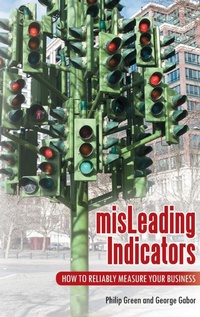
misLeading Indicators
How to Reliably Measure Your Business
Published on 22. February 2012
Book
Hardback
304 pages
978-0-313-39595-6 (ISBN)
Description
This book reveals the hidden and potentially misleading nature of measurements, empowering readers to avoid making critical business decisions that are harmful, unreasonable, unwarranted, or plain wrong.
Decision makers in business and government are more reliant than ever on measurements, such as business performance indicators, bond ratings, Six-Sigma indicators, stock ratings, opinion polls, and market research. Yet many popular statistical and business books and courses relating to measurement are based on flawed principles, leading managers to the wrong conclusions-and ultimately, the wrong decisions. misLeading Indicators: How to Reliably Measure Your Business provides something unique and invaluable: trustworthy tools for judging measurements.
Each chapter illustrates the four key principles for reliable measurements: sufficient background information, accuracy and precision, reasonable inferences, and reality checks in different situations. After the three fundamental methods of measuring are defined, the authors expand to the application and interpretation of measurements in specific areas, including business performance, risk management, process, control, finance, and economics. This book supplies essential information for managers in business and government who depend on accurate information to run their organizations, as well as the consultants who advise them.
Decision makers in business and government are more reliant than ever on measurements, such as business performance indicators, bond ratings, Six-Sigma indicators, stock ratings, opinion polls, and market research. Yet many popular statistical and business books and courses relating to measurement are based on flawed principles, leading managers to the wrong conclusions-and ultimately, the wrong decisions. misLeading Indicators: How to Reliably Measure Your Business provides something unique and invaluable: trustworthy tools for judging measurements.
Each chapter illustrates the four key principles for reliable measurements: sufficient background information, accuracy and precision, reasonable inferences, and reality checks in different situations. After the three fundamental methods of measuring are defined, the authors expand to the application and interpretation of measurements in specific areas, including business performance, risk management, process, control, finance, and economics. This book supplies essential information for managers in business and government who depend on accurate information to run their organizations, as well as the consultants who advise them.
More details
Language
English
Place of publication
United States
Publishing group
Bloomsbury Publishing Plc
Target group
College/higher education
Dimensions
Height: 240 mm
Width: 161 mm
Thickness: 21 mm
Weight
622 gr
ISBN-13
978-0-313-39595-6 (9780313395956)
Copyright in bibliographic data and cover images is held by Nielsen Book Services Limited or by the publishers or by their respective licensors: all rights reserved.
Schweitzer Classification
Other editions
Additional editions
E-Book
02/2012
1st Edition
Praeger Publishers Inc
from
€61.89
Available for download
E-Book
02/2012
1st Edition
Praeger Publishers Inc
€55.99
Available for download
Persons
Philip Green is chairman and CEO of First Resource Management Group, Inc.
George Gabor, now retired, was professor of statistics at Dalhousie University, Halifax, Nova Scotia.
George Gabor, now retired, was professor of statistics at Dalhousie University, Halifax, Nova Scotia.
Content
Preface
Acknowledgments
ONE: What Indicators Indicate
TWO: Counting, Recounting, and Miscounting
THREE: Measuring Accurately with Instruments
FOUR: Rating, Scoring, and Ranking Reliably
FIVE: How People React to Measurements
SIX: Why Performance Dashboards Mislead
SEVEN: Focusing Employees with Measurements
EIGHT: Going Against the Flow: Navigating Changing Data Streams
NINE: How Averages Distort Indicators
TEN: Opposing Views: Are You Being Misled?
ELEVEN: Misleading Ourselves with Measurements of Risk
Notes
Bibliography
Index
Acknowledgments
ONE: What Indicators Indicate
TWO: Counting, Recounting, and Miscounting
THREE: Measuring Accurately with Instruments
FOUR: Rating, Scoring, and Ranking Reliably
FIVE: How People React to Measurements
SIX: Why Performance Dashboards Mislead
SEVEN: Focusing Employees with Measurements
EIGHT: Going Against the Flow: Navigating Changing Data Streams
NINE: How Averages Distort Indicators
TEN: Opposing Views: Are You Being Misled?
ELEVEN: Misleading Ourselves with Measurements of Risk
Notes
Bibliography
Index