

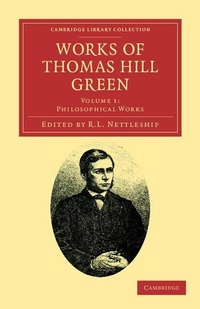
Works of Thomas Hill Green
Published on 22. December 2011
Book
Paperback/Softback
576 pages
978-1-108-03680-1 (ISBN)
Description
Thomas Hill Green (1836-82) was one of the most influential English thinkers of his time, and he made significant contributions to the development of political liberalism. Much of his career was spent at Balliol College, Oxford: having begun as a student of Jowett, he later acted effectively as his second-in-command at the college. Interested for his whole career in social questions, Green supported the temperance movement, the extension of the franchise, and the admission of women to university education. He became Whyte's professor of moral philosophy at Oxford in 1878, and his lectures had a lasting influence on a generation of students. Much of Volume 1, edited by Green's pupil R. L. Nettleship and published in 1885, consists of Green's work on David Hume (1711-76). In his essay, 'Introductions to Hume's Treatise of Human Nature' (originally published in 1874), Green gives a detailed critique of Hume's metaphysical thought.
More details
Series
Language
English
Place of publication
Cambridge
United Kingdom
Target group
College/higher education
Professional and scholarly
Product notice
Paperback (trade)
Illustrations
Worked examples or Exercises
Dimensions
Height: 216 mm
Width: 140 mm
Thickness: 34 mm
Weight
802 gr
ISBN-13
978-1-108-03680-1 (9781108036801)
Copyright in bibliographic data and cover images is held by Nielsen Book Services Limited or by the publishers or by their respective licensors: all rights reserved.
Schweitzer Classification
Content
Preface; Introductions to Hume's Treatise of Human Nature: 1. General introduction; 2. Introduction to the moral part of Hume's Treatise; Mr. Herbert Spencer and Mr. G. H. Lewes: Their Application of the Doctrine of Evolution to Thought: 1. Mr. Spencer on the relation of subject and object; 2. Mr. Spencer on the independence of matter; 3. Mr. Lewes' account of experience; 4. Mr. Lewes' account of the 'social medium'; 5. An answer to Mr. Hodgson.