

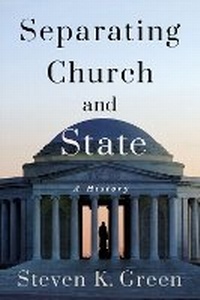
Separating Church and State
A History
Published on 15. March 2022
Book
Hardback
246 pages
978-1-5017-6206-2 (ISBN)
Description
Steven K. Green, renowned for his scholarship on the separation of church and state, charts the career of the concept and helps us understand how it has fallen into disfavor with many Americans.
In 1802, President Thomas Jefferson distilled a leading idea in the early American republic and wrote of a wall of separation between church and state. That metaphor has come down from Jefferson to twenty-first-century Americans through a long history of jurisprudence, political contestation, and cultural influence. This book traces the development of the concept of separation of church and state and the Supreme Court's application of it in the law.
Green finds that conservative criticisms of a separation of church and state overlook the strong historical and jurisprudential pedigree of the idea. Yet, arguing with liberal advocates of the doctrine, he notes that the idea remains fundamentally vague and thus open to loose interpretation in the courts. As such, the history of a wall of separation is more a variable index of American attitudes toward the forces of religion and state.
Indeed, Green argues that the Supreme Court's use of the wall metaphor has never been essential to its rulings. The contemporary battle over the idea of a wall of separation has thus been a distraction from the real jurisprudential issues animating the contemporary courts.
In 1802, President Thomas Jefferson distilled a leading idea in the early American republic and wrote of a wall of separation between church and state. That metaphor has come down from Jefferson to twenty-first-century Americans through a long history of jurisprudence, political contestation, and cultural influence. This book traces the development of the concept of separation of church and state and the Supreme Court's application of it in the law.
Green finds that conservative criticisms of a separation of church and state overlook the strong historical and jurisprudential pedigree of the idea. Yet, arguing with liberal advocates of the doctrine, he notes that the idea remains fundamentally vague and thus open to loose interpretation in the courts. As such, the history of a wall of separation is more a variable index of American attitudes toward the forces of religion and state.
Indeed, Green argues that the Supreme Court's use of the wall metaphor has never been essential to its rulings. The contemporary battle over the idea of a wall of separation has thus been a distraction from the real jurisprudential issues animating the contemporary courts.
Reviews / Votes
This book opens an interesting dialogue about the concept in the early days of the Constitution, which is of particular importance to recent religion cases decided by the Supreme Court and to all looking to understand the Court's religious jurisprudence.(Choice)
More details
Series
Language
English
Place of publication
Ithaca
United States
Product notice
Paper over boards
Dimensions
Height: 229 mm
Width: 152 mm
Thickness: 24 mm
Weight
907 gr
ISBN-13
978-1-5017-6206-2 (9781501762062)
Copyright in bibliographic data and cover images is held by Nielsen Book Services Limited or by the publishers or by their respective licensors: all rights reserved.
Schweitzer Classification
Other editions
Additional editions
E-Book
03/2022
Cornell University Press
€32.99
Available for download
Person
Steven K. Green is the Fred H. Paulus Professor of Law and Affiliated Professor of History and Religious Studies at Willamette University. He is the author of five books and more than forty scholarly articles on the intersection of history, law, and religion.
Content
Introduction
1. Historical Antecedents of Separationism
2. Disestablishment and Separationism
3. The Early National Period
4. The Protestant Establishment of the Nineteenth Century
5. Separation Becomes Constitutional Canon
6. Separation's Apex and Decline
Conclusion
1. Historical Antecedents of Separationism
2. Disestablishment and Separationism
3. The Early National Period
4. The Protestant Establishment of the Nineteenth Century
5. Separation Becomes Constitutional Canon
6. Separation's Apex and Decline
Conclusion