

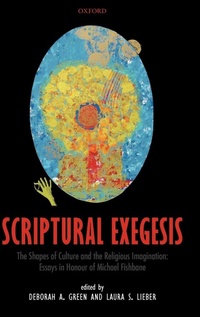
Scriptural Exegesis
The Shapes of Culture and the Religious Imagination: Essays in Honour of Michael Fishbane
Published on 26. February 2009
Book
Hardback
340 pages
978-0-19-920657-5 (ISBN)
Description
Scriptural Exegesis gathers voices from an international community of scholars to consider the many facets of the history of biblical interpretation and to question how exegesis shapes spiritual and cultural creativity. Divided into four broadly chronological sections that chart a variety of approaches from ancient to modern times, the essays examine texts and problems rooted in the ancient world yet still of concern today. Eighteen chapters incorporate the expertise of contributors from a diverse range of disciplines, including ancient religion, philosophy, mysticism, and folklore. Each embraces the challenge of explicating complex and often esoteric writings in light of Michael Fishbane's groundbreaking work in exegesis.
Reviews / Votes
It is a fitting tribute to a distinguished scholar that this Festschrift covers so much ground ... these are detailed technical papers which offer penetrating analysis and fascinating insights into neglected aspects of the Jewish and Christian interpretative traditions. * Alan Le Grys, Journal for the Study of the New Testament *More details
Language
English
Place of publication
Oxford
United Kingdom
Target group
College/higher education
Dimensions
Height: 240 mm
Width: 161 mm
Thickness: 23 mm
Weight
675 gr
ISBN-13
978-0-19-920657-5 (9780199206575)
Copyright in bibliographic data and cover images is held by Nielsen Book Services Limited or by the publishers or by their respective licensors: all rights reserved.
Schweitzer Classification
Persons
Content
Introduction ; I: THE ANCIENT NEAR EAST AND HEBREW BIBLE: THE SHAPE OF THE TEXT ; 1. Myth as historia divina and historia sacra ; 2. The Neo-Assyrian origins of the canon formula in Deuteronomy 13:1 ; 3. Traditum and traditio: The case of Deuteronomy 17:14-20 ; 4. The riddle of Psalm 111 ; 5. Calling God names: An inner-biblical approach to the Tetragrammaton ; II: INTERTESTAMENTAL, POSTBIBLICAL, AND RABBINIC LITERATURE: REIMAGINING THE TEXT ; 6. The Suffering Servant: From Isaiah to the Dead Sea Scrolls ; 7. The Work of the Chariot and the Work of Creation as mystical teachings in Philo of Alexandria ; 8. A rabbinic disquisition of Leviticus 26:3-13: A utopian vision between Jews and Christians ; 9. Yearning for intimacy: Pesikta d'Rav Kahana and the temple ; 10. 'If the text had not been written, it could not be said' ; III: THE MEDIEVAL PERIOD: A NEW TEXTUAL IMAGINATION ; 11. Cain, Abel, and brutism ; 12. 'Sage is preferable to prophet': Revisioning midrashic imagination ; 13. On angels and biblical exegesis in thirteenth-century Ashkenaz ; 14. 'Virgil in the Basket': Narrative as hermeneutics in Hebrew literature of the Middle Ages ; 15. Fabula: Concerning Christian exegesis in the Middle Ages ; 16. Women reading the Song of Songs in the Christian tradition ; IV: THE MODERN PERIOD: THE HUMAN AND DIVINE IN THE TEXT ; 17. Finding the radiance in the text: A Habad hasidic interpretation of the Exodus ; 18. Between sensual and heavenly love: Franz Rosenzweig's reading of the Song of Songs