

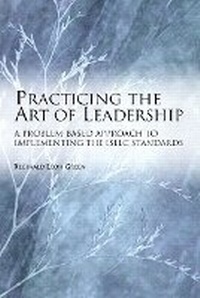
Practicing the Art of Leadership
A Problem-based Approach to Implementing the ISLLC Standards
Published on 10. May 2001
Book
Paperback/Softback
252 pages
978-0-13-020364-9 (ISBN)
Description
This book is best suited for a culminating or practicum course in a graduate educational leadership preparation program.
This self-help book introduces a number of scenarios that incorporate the behaviors supported by the ISLLC Standards. Its effective case scenario approach prepares prospective school leaders to address actual school challenges that occur on a daily basis. In addition, it familiarizes students with the ISSLC Standards and enables them to conduct a self-assessment relative to meeting those standards. Unlike similar texts, the author provides responses to difficult and challenging issues that are grounded in theory and supported by best practice. This enables students to examine, compare, and make decisions about well-documented responses and in turn, apply their own ideas.
This self-help book introduces a number of scenarios that incorporate the behaviors supported by the ISLLC Standards. Its effective case scenario approach prepares prospective school leaders to address actual school challenges that occur on a daily basis. In addition, it familiarizes students with the ISSLC Standards and enables them to conduct a self-assessment relative to meeting those standards. Unlike similar texts, the author provides responses to difficult and challenging issues that are grounded in theory and supported by best practice. This enables students to examine, compare, and make decisions about well-documented responses and in turn, apply their own ideas.
Reviews / Votes
"Reginald Green delivers everything the title of his book promises: Effecting a connection between theory and practice in leadership and providing an innovative strategy for doing so. However, he exceeds his promise by leading the reader through a comprehensive overview of the field of educational administration."-- John I. Goodlad, President, Institute for Educational Inquiry. "As expectations of schools increase, the job of the school principal grows ever more complex. Reginald Green's book is a valuable resource for those concerned with developing leadership for 21st century schools that are collaborative, learning-focused, and successful with a wide range of diverse learners."-- Linda Darling-Hammond, Charles E. Ducommun Professor of Education, Stanford University. "Dr. Green has created numerous, practical scenarios to help aspiring school leaders apply the ISLLC standards in day-to-day situations.These scenarios will encourage higher order reflections so crucial to a school leader's success, as designed, Dr. Green's activities and scenarios will be superb practice for students preparing to take the ISLLC/ETS school leaders licensure assessment. In addition to the practicality for students, the exercises provided to assist professors will enhance their classes and field experiences. I can hardly wait to put the ideas in this book to use with my students. The only problem is all the professors in our department will be competing for it!"-- Neil J. Shipman, EdD., Director, Interstate School Leaders Licensure Consortium.More details
Language
English
Place of publication
United States
Publishing group
Pearson Education (US)
Target group
Professional and scholarly
Dimensions
Height: 229 mm
Width: 152 mm
Weight
340 gr
ISBN-13
978-0-13-020364-9 (9780130203649)
Copyright in bibliographic data and cover images is held by Nielsen Book Services Limited or by the publishers or by their respective licensors: all rights reserved.
Schweitzer Classification
Other editions
New editions
Reginald Leon Green
Practicing the Art of Leadership
A Problem-based Approach to Implementing the ISLLC Standards
Book
06/2004
2nd Edition
Pearson
€37.13
Article exhausted; check for reprint
Person
Reginald Leon Green, is Associate Professor of Educational Leadership at the University of Memphis. He received the Ed.D. in Educational Administration and Supervision from the University of Missouri-Columbia. He has served at the teacher, principal, deputy superintendent, and superintendent levels of K-12 education, and has been in higher education for seven years. In 1977, Reginald was one of five educators chosen nationally to participate in the Rockefeller Foundation's Superintendency Preparation Program, and, in 1996, he was selected as an associate to the Institute for Educational Renewal, under the leadership of Dr. John Goodlad.
Reginald had published a book on inner-city education and articles on educational restructuring, primary grade restructuring, gang violence, and other contemporary educational issues. Most recently, he completed national inquiries into nurturing characteristics that exist in schools and standards and assessment measures being established as a part of school reform. Dr. Green teaches courses in educational leadership, organizational behavior, and participatory governance and change. His research interests include school leadership, superintendent/board relations, school district restructuring, and the effects of nurturing characteristics on the academic achievement of students.
Reginald had published a book on inner-city education and articles on educational restructuring, primary grade restructuring, gang violence, and other contemporary educational issues. Most recently, he completed national inquiries into nurturing characteristics that exist in schools and standards and assessment measures being established as a part of school reform. Dr. Green teaches courses in educational leadership, organizational behavior, and participatory governance and change. His research interests include school leadership, superintendent/board relations, school district restructuring, and the effects of nurturing characteristics on the academic achievement of students.
Content
Introduction.
1. Leadership in Today's Schools.
2. Organizational Influences on Leadership.
3. Communication in Today's Schools.
4. Decision Making: Quality and Acceptance.
5. Managing Conflict in Today's Schools.
6. Facilitating Change in Schools.
References.
Index.
1. Leadership in Today's Schools.
2. Organizational Influences on Leadership.
3. Communication in Today's Schools.
4. Decision Making: Quality and Acceptance.
5. Managing Conflict in Today's Schools.
6. Facilitating Change in Schools.
References.
Index.