

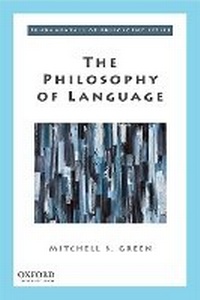
Philosophy Of Language
Published on 28. September 2020
Book
Paperback/Softback
208 pages
978-0-19-085304-4 (ISBN)
Description
Mitchell Green's The Philosophy of Language is ideal for both undergraduate and graduate philosophy of language courses. Featuring a lucid and engaging writing style, it provides a succinct and accessible introduction to the field. Designed for ready use with primary sources, it offers numerous pointers to work from classic and contemporary philosophers, including Frege, Russell, Wittgenstein, Kripke, Davidson, Quine, Grice, and others. The book also
highlights contemporary research, including non-ideal philosophy of language--such as work on slurs and communicative injustice--and the relation of language to aesthetic questions through such topics as fictional
discourse, metaphor, and irony. Each chapter is enhanced by study questions and suggestions for further reading. An appendix and a glossary facilitate quick retrieval of many of the high-level concepts.
highlights contemporary research, including non-ideal philosophy of language--such as work on slurs and communicative injustice--and the relation of language to aesthetic questions through such topics as fictional
discourse, metaphor, and irony. Each chapter is enhanced by study questions and suggestions for further reading. An appendix and a glossary facilitate quick retrieval of many of the high-level concepts.
More details
Language
English
Place of publication
New York
United States
Target group
College/higher education
Weight
245 gr
ISBN-13
978-0-19-085304-4 (9780190853044)
Copyright in bibliographic data and cover images is held by Nielsen Book Services Limited or by the publishers or by their respective licensors: all rights reserved.
Schweitzer Classification
Person
Mitchell S. Green is Professor of Philosophy at the University of Connecticut. He is the author of several books, including Self-Expression (OUP, 2008), and the coeditor, with John N. Williams, of Moore's Paradox: New Essays on Belief, Rationality, and the First Person (OUP, 2007).
Content
List of Figures, Tables, and Boxes Preface CHAPTER 1. Meaning: Varieties, Aspects, and Sources 1.1. Some Varieties of Meaning 1.2. Eleven Aspects of Communicative Meaning 1.3. Where Does Linguistic Meaning Come from? 1.4. What Is Language? 1.5. Philosophy and Other Approaches to Language 1.6. Study Questions and Suggestions for Further Reading CHAPTER 2. Characterizing Linguistic Meaning 2.1. Constraints on Characterization
2.2. Dictionaries 2.3. Ideas 2.4. Verification Conditions 2.5. Usage, Emotivism, and the Autonomy of Meaning 2.6. Study Questions and Suggestions for Further Reading CHAPTER 3. Linguistic Meaning and Truth Conditions 3.1. Speaking of Nothing 3.2. Quantifiers and Other Logical Constants 3.3. Descriptions 3.4. Truth-Conditional Semantics and Linguistic Meaning 3.5. Study Questions and Suggestions for Further Reading CHAPTER 4. Sense and Reference 4.1. Millian Heirs: The Theory of Direct Reference
4.2. Making Sense 4.3. Objections to the Descriptive Theory of Names 4.4. Direct Reference Returns, and Some Nihilism 4.5. The New Fregeans 4.6. Study Questions and Suggestions for Further Reading CHAPTER 5. Speech Acts and Conversations 5.1. Locution, Illocution, Perlocution 5.2. Speaker Meaning 5.3. Varieties of Speech Acts and Conversations 5.4. Infelicities: Misfires and Abuses 5.5. Indirect Speech Acts 5.6. Study Questions and Suggestions for Further Reading CHAPTER 6. Context Sensitivity, Implicature, and Presupposition 6.1. Indexicals: Character and Content 6.2. Implicature: Conventional, Conversational, and Beyond 6.3. Presupposition: Semantic and Pragmatic 6.4. Explicature 6.5. Study Questions and Suggestions for Further Reading CHAPTER 7. Despicable Discourse 7.1. Injustice and Malfeasance in Language 7.2. Slurs and Epithets 7.3. Generics 7.4. Silencing, Distorting, and Subordinating 7.5. Paths to Amelioration 7.6. Study Questions and Suggestions for Further Reading CHAPTER 8. Artful Language: Fiction, Metaphor, Irony, and Jokes 8.1. Fictional Discourse 8.2. Similes and Metaphors 8.3. Irony 8.4. Jokes 8.5. Study Questions and Suggestions for Further Reading Appendix: Eleven Features of Communicative Meaning Glossary Index
Contents ix
2.2. Dictionaries 2.3. Ideas 2.4. Verification Conditions 2.5. Usage, Emotivism, and the Autonomy of Meaning 2.6. Study Questions and Suggestions for Further Reading CHAPTER 3. Linguistic Meaning and Truth Conditions 3.1. Speaking of Nothing 3.2. Quantifiers and Other Logical Constants 3.3. Descriptions 3.4. Truth-Conditional Semantics and Linguistic Meaning 3.5. Study Questions and Suggestions for Further Reading CHAPTER 4. Sense and Reference 4.1. Millian Heirs: The Theory of Direct Reference
4.2. Making Sense 4.3. Objections to the Descriptive Theory of Names 4.4. Direct Reference Returns, and Some Nihilism 4.5. The New Fregeans 4.6. Study Questions and Suggestions for Further Reading CHAPTER 5. Speech Acts and Conversations 5.1. Locution, Illocution, Perlocution 5.2. Speaker Meaning 5.3. Varieties of Speech Acts and Conversations 5.4. Infelicities: Misfires and Abuses 5.5. Indirect Speech Acts 5.6. Study Questions and Suggestions for Further Reading CHAPTER 6. Context Sensitivity, Implicature, and Presupposition 6.1. Indexicals: Character and Content 6.2. Implicature: Conventional, Conversational, and Beyond 6.3. Presupposition: Semantic and Pragmatic 6.4. Explicature 6.5. Study Questions and Suggestions for Further Reading CHAPTER 7. Despicable Discourse 7.1. Injustice and Malfeasance in Language 7.2. Slurs and Epithets 7.3. Generics 7.4. Silencing, Distorting, and Subordinating 7.5. Paths to Amelioration 7.6. Study Questions and Suggestions for Further Reading CHAPTER 8. Artful Language: Fiction, Metaphor, Irony, and Jokes 8.1. Fictional Discourse 8.2. Similes and Metaphors 8.3. Irony 8.4. Jokes 8.5. Study Questions and Suggestions for Further Reading Appendix: Eleven Features of Communicative Meaning Glossary Index
Contents ix