

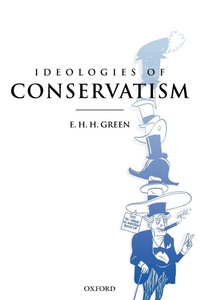
Ideologies of Conservatism
Conservative Political Ideas in the Twentieth Century
Published on 24. June 2004
Book
Paperback/Softback
320 pages
978-0-19-927033-0 (ISBN)
Description
John Stuart Mill described the Conservatives as 'the stupidest party', yet they governed the UK for nearly three-quarters of the twentieth century. Conservative leaders typically have been and are explicitly anti-intellectual, yet the party is not without an intellectual history of its own.
Ideologies of Conservatism charts developments and changes in the nature of Conservative political thought and the meaning of Conservatism throughout the twentieth century. Ewen Green's penetrating study explores the Conservative mind from the Edwardian crisis under Balfour to the Thatcherite 1980s and beyond. It examines how Conservative thinkers, politicians, and activists sought to define the problems they faced, what they thought they were arguing against, and what audiences they were seeking to reach. This is the only study which blends the history of Conservative thought with the party's political action, and it offers significant new insights into the political culture of the 'Conservative Century'.
Ideologies of Conservatism charts developments and changes in the nature of Conservative political thought and the meaning of Conservatism throughout the twentieth century. Ewen Green's penetrating study explores the Conservative mind from the Edwardian crisis under Balfour to the Thatcherite 1980s and beyond. It examines how Conservative thinkers, politicians, and activists sought to define the problems they faced, what they thought they were arguing against, and what audiences they were seeking to reach. This is the only study which blends the history of Conservative thought with the party's political action, and it offers significant new insights into the political culture of the 'Conservative Century'.
Reviews / Votes
Review from hardback edition... erudite ... important, well-organized and lucid ... Green's authoritative handling of the intricacies of economic thought is extremely valuable and his material is clearly and thematically presented. Ideologies of Conservatism should be vital reading not only for historians of the Conservative party and of Conservative thought but for those interested in the intellectual history of Britain and in the fortunes of corporatist ideas in the twentieth century. * MODERNISM/modernity * Review from previous edition Ideologies of Conservatism will be a great eye-opener to to historians and philosophers alike...A first rate, indispensable book...Green's conclusions are cautious, provisional, and based always on scrupulous consideration of the copious evidence and (most importantly) counter-evidence which his impressive industry has unearthed, often from very obscure, unpublished sources. * Times Literary Supplement * Superbly-researched essays on episodes in Conservative history since 1903...Green has made an impressive and rich contribution. * English Historical Review * Easy to read and well worth reading...Green is a first-rate historian * London Review of Books * Rewarding and provocative assembly of essays...There is a unifying theme running through the book to which each essay makes an accumulating contribution, and which creates both unity and progression in the whole enterprise * European Review of History *
More details
Language
English
Place of publication
Oxford
United Kingdom
Target group
Professional and scholarly
Readers with an interest in the current Conservative party, historians of twentieth century politics, intellectual historians, political scientists.
Dimensions
Height: 234 mm
Width: 156 mm
Thickness: 17 mm
Weight
488 gr
ISBN-13
978-0-19-927033-0 (9780199270330)
Copyright in bibliographic data and cover images is held by Nielsen Book Services Limited or by the publishers or by their respective licensors: all rights reserved.
Schweitzer Classification
Person
E. H. H. GREEN, Fellow and Tutor in Modern History, Magdalen College, Oxford
Content
Introduction ; 1. 'No Settled Convictions'? Arthur Balfour, Political Economy, and Tariff Reform: A Reconsideration ; 2. English Idealism, Conservatism, and Collectivism 1880-1914 ; 3. An Intellectual in Conservative Politics: The Case of Arthur Steel-Maitland ; 4. Conservatism, Anti-Socialism, and the End of the Lloyd George Coalition ; 5. The Battle of the Books: Book Clubs and Conservatism in the 1930s ; 6. Searching for the Middle Way: The Political Economy of Harold Macmillan ; 7. The Treasury Resignations of 1958: A Reconsideration ; 8. Thatcherism: A Historical Perspective ; 9. Conservatism, the State, and Civil Society in the Twentieth Century ; Conclusion ; Bibliography ; Index