

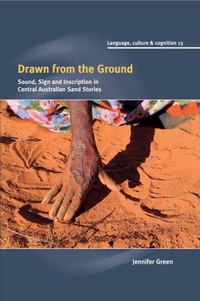
Drawn from the Ground
Sound, Sign and Inscription in Central Australian Sand Stories
Published on 22. August 2019
Book
Paperback/Softback
288 pages
978-1-316-64536-9 (ISBN)
Description
Sand stories from Central Australia are a traditional form of Aboriginal women's verbal art that incorporates speech, song, sign, gesture and drawing. Small leaves and other objects may be used to represent story characters. This detailed study of Arandic sand stories takes a multimodal approach to the analysis of the stories and shows how the expressive elements used in the stories are orchestrated together. This richly illustrated volume is essential reading for anyone interested in language and communication. It adds to the growing recognition that language encompasses much more than speech alone, and shows how important it is to consider the different semiotic resources a culture brings to its communicative tasks as an integrated whole rather than in isolation.
Reviews / Votes
'It is a commonplace to note that humans communicate with one another in many different ways. It is rare, however, to encounter analyses of human communication which display analytically the complex nature of how the semiotic ensemble humans make use of may be organised. Drawn from the Ground is an outstanding example of such an analysis. Besides being a very significant contribution to our understanding of an important and interesting cultural practice among central Australian Aborigines, this book is remarkable for the insightful way in which it demonstrates how diverse semiotic modalities function in relation to one another. An extremely valuable piece of work.' Adam Kendon, University of Pennsylvania and University College London 'This tour de force draws the study of a language in a totally new direction. Through her close study of Central Australian women's storytelling traditions - and this investigation is steeped in the insights of decades of deep linguistic and cultural immersion - Jennifer Green shows how much we gain in semiotic understanding when we reintegrate the fractured family of our communicative modalities. Speech, chant, gesture but also a particular Central Australian tradition of dynamic drawing on specially-prepared sand surfaces, are all turned to the task of heightening narrative intensity, and the book tackles the challenge of reuniting all these channels analytically, in a way that fully captures the experiential vividness of the storytelling. The publisher, Cambridge University Press, is to be commended on including several strikingly sumptuous colour plates that give some feel for the visual richness of the sand-drawing genre.' Nicholas Evans, Australian National University, CanberraMore details
Series
Language
English
Place of publication
Cambridge
United Kingdom
Target group
Professional and scholarly
Product notice
Paperback (trade)
Illustrations
15 Printed music items; 14 Tables, black and white; 10 Plates, color; 1 Maps; 115 Halftones, black and white; 15 Line drawings, black and white
Dimensions
Height: 229 mm
Width: 152 mm
Thickness: 15 mm
Weight
390 gr
ISBN-13
978-1-316-64536-9 (9781316645369)
Copyright in bibliographic data and cover images is held by Nielsen Book Services Limited or by the publishers or by their respective licensors: all rights reserved.
Schweitzer Classification
Other editions
Additional editions
Book
05/2014
Cambridge University Press
€117.50
Shipment within 15-20 days
Person
Jennifer Green is a Research Fellow in the School of Languages and Linguistics at the University of Melbourne. She has over 30 years' experience working on projects documenting indigenous languages, history and visual arts.
Content
1. Introduction; 2. Sand stories as social and cultural practice; 3. Catching a move as it flies: multimodal data collection; 4. Lines in the sand; 5. Body-anchored and airborne action; 6. Ordering, re-drawing and erasure; 7. Vocal style in sand stories; 8. Crossing boundaries.