

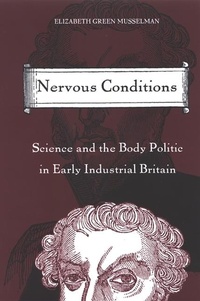
Nervous Conditions
Science and the Body Politic in Early Industrial Britain
Published on 1. January 2007
Book
Paperback/Softback
288 pages
978-0-7914-6680-3 (ISBN)
Description
Examines nineteenth-century scientists' obsession with nerves and the nervous system.
Nervous Conditions explores the role of the body in the development of modern science, challenging the myth that modern science is built on a bedrock of objectivity and confident empiricism. In this fascinating look into the private world of British natural philosophers-including John Dalton, Lord Kelvin, Charles Babbage, John Herschel, and many others-Elizabeth Green Musselman shows how the internal workings of their bodies played an important part in the sciences' movement to the center of modern life, and how a scientific community and a nation struggled their way into existence.
Many of these natural philosophers endured serious nervous difficulties, particularly vision problems. They turned these weaknesses into strengths, however, by claiming that their well-disciplined mental skills enabled them to transcend their bodily frailties. Their adeptness at transcendence, they asserted, explained why men of science belonged at the heart of modern life, and qualified them to address such problems as unifying the British provinces into one nation, managing the industrial workplace, and accommodating religious plurality.
Nervous Conditions explores the role of the body in the development of modern science, challenging the myth that modern science is built on a bedrock of objectivity and confident empiricism. In this fascinating look into the private world of British natural philosophers-including John Dalton, Lord Kelvin, Charles Babbage, John Herschel, and many others-Elizabeth Green Musselman shows how the internal workings of their bodies played an important part in the sciences' movement to the center of modern life, and how a scientific community and a nation struggled their way into existence.
Many of these natural philosophers endured serious nervous difficulties, particularly vision problems. They turned these weaknesses into strengths, however, by claiming that their well-disciplined mental skills enabled them to transcend their bodily frailties. Their adeptness at transcendence, they asserted, explained why men of science belonged at the heart of modern life, and qualified them to address such problems as unifying the British provinces into one nation, managing the industrial workplace, and accommodating religious plurality.
Reviews / Votes
Many of these natural philosophers endured serious nervous difficulties, particularly vision problems. They turned these weaknesses into strengths, however, by claiming that their well-disciplined mental skills enabled them to transcend their bodily frailties. Their adeptness at transcendence, they asserted, explained why men of science belonged at the heart of modern life, and qualified them to address such problems as unifying the British provinces into one nation, managing the industrial workplace, and accommodating religious plurality.More details
Series
Language
English
Place of publication
Albany, NY
United States
Target group
College/higher education
Professional and scholarly
US School Grade: College Graduate Student and over
Product notice
Paperback (trade)
Dimensions
Height: 229 mm
Width: 153 mm
Thickness: 15 mm
Weight
340 gr
ISBN-13
978-0-7914-6680-3 (9780791466803)
Copyright in bibliographic data and cover images is held by Nielsen Book Services Limited or by the publishers or by their respective licensors: all rights reserved.
Schweitzer Classification
Other editions
Additional editions
Elizabeth Green Musselman
Nervous Conditions
Science and the Body Politic in Early Industrial Britain
E-Book
02/2012
1st Edition
De Gruyter
€36.49
Available for download
Person
Elizabeth Green Musselman is Associate Professor of History at Southwestern University.