

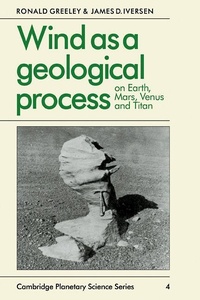
Wind as a Geological Process
On Earth, Mars, Venus and Titan
Published on 28. August 1987
Book
Paperback/Softback
348 pages
978-0-521-35962-7 (ISBN)
Description
This book gives an account of geological aspects of windblown material. Aeolian processes play an important role in modifying the surface of the Earth, and they are also active on Mars. Additionally, they are thought to occur on Venus and possibly Titan as well. The authors describe the following aspects: wind as a geological process, the aeolian environment, physics of particle motion, aeolian abrasion and erosion; aeolian sand deposits and bedforms, interaction of wind and topography and windblown dust. A particular strength of the book is that it deals with aeolian processes in a planetary context, rather than as a purely terrestrial phenomenon. In so doing, the authors ably demonstrate how we can gain better understanding of the Earth through comparative planetology. This paperback reissue will enable the book to be used as a text for advanced students in planetary science. Special terms are defined when they are first used. There is a glossary and an exhaustive bibliography.
More details
Series
Language
English
Place of publication
Cambridge
United Kingdom
Target group
College/higher education
Product notice
Paperback (trade)
Illustrations
Worked examples or Exercises
Dimensions
Height: 229 mm
Width: 152 mm
Thickness: 21 mm
Weight
565 gr
ISBN-13
978-0-521-35962-7 (9780521359627)
Copyright in bibliographic data and cover images is held by Nielsen Book Services Limited or by the publishers or by their respective licensors: all rights reserved.
Schweitzer Classification
Other editions
Additional editions

Book
03/1985
Cambridge University Press
€74.40
Article exhausted; check for reprint
Previous edition
Book
03/1985
Cambridge University Press
€74.40
Article exhausted; check for reprint
Content
1. Wind as a geological process; 2. The aeolian environment; 3. Physics of particle motion; 4. Aeolian abrasion and erosion; 5. Aeolian sand deposits and bedforms; 6. Interaction of wind and topography; 7. Windblown dust.