

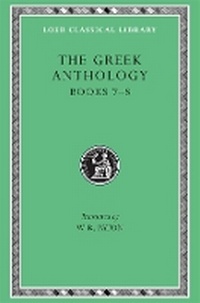
The Greek Anthology, Volume II
Books 7-8
LOEB (Publisher)
Published on 1. January 1917
Book
Hardback
528 pages
978-0-674-99075-3 (ISBN)
Description
A gathering of poetic blossoms.
The Greek Anthology (literally, "Gathering of Flowers") is the name given to a collection of about 4500 short Greek poems (called epigrams but usually not epigrammatic) by about 300 composers. To the collection (called Stephanus, literally, "wreath" or "garland") made and contributed to by Meleager of Gadara (1st century BC) was added another by Philippus of Thessalonica (late 1st century AD), a third by Diogenianus (2nd century), and much later a fourth, called the Circle, by Agathias of Myrina. These (lost) and others (also lost) were partly incorporated, arranged according to contents, by Constantinus Cephalas (early 10th century?) into fifteen books now preserved in a single manuscript of the Palatine Library at Heidelberg. The grand collection was rearranged and revised by the monk Maximus Planudes (14th century) who also added epigrams lost from Cephalas' compilation.
The fifteen books of the Palatine Anthology are: I, Christian Epigrams; II, Descriptions of Statues; III, Inscriptions in a temple at Cyzicus; IV, Prefaces of Meleager, Philippus, and Agathias; V, Amatory Epigrams; VI, Dedicatory; VII, Sepulchral; VIII, Epigrams of St. Gregory; IX, Declamatory; X, Hortatory and Admonitory; XI, Convivial and Satirical; XII, Strato's "Musa Puerilis"; XIII, Metrical curiosities; XIV, Problems, Riddles, and Oracles; XV, Miscellanies. Book XVI is the Planudean Appendix: Epigrams on works of art.
Outstanding among the poets are Meleager, Antipater of Sidon, Crinagoras, Palladas, Agathias, Paulus Silentiarius.
The Greek Anthology (literally, "Gathering of Flowers") is the name given to a collection of about 4500 short Greek poems (called epigrams but usually not epigrammatic) by about 300 composers. To the collection (called Stephanus, literally, "wreath" or "garland") made and contributed to by Meleager of Gadara (1st century BC) was added another by Philippus of Thessalonica (late 1st century AD), a third by Diogenianus (2nd century), and much later a fourth, called the Circle, by Agathias of Myrina. These (lost) and others (also lost) were partly incorporated, arranged according to contents, by Constantinus Cephalas (early 10th century?) into fifteen books now preserved in a single manuscript of the Palatine Library at Heidelberg. The grand collection was rearranged and revised by the monk Maximus Planudes (14th century) who also added epigrams lost from Cephalas' compilation.
The fifteen books of the Palatine Anthology are: I, Christian Epigrams; II, Descriptions of Statues; III, Inscriptions in a temple at Cyzicus; IV, Prefaces of Meleager, Philippus, and Agathias; V, Amatory Epigrams; VI, Dedicatory; VII, Sepulchral; VIII, Epigrams of St. Gregory; IX, Declamatory; X, Hortatory and Admonitory; XI, Convivial and Satirical; XII, Strato's "Musa Puerilis"; XIII, Metrical curiosities; XIV, Problems, Riddles, and Oracles; XV, Miscellanies. Book XVI is the Planudean Appendix: Epigrams on works of art.
Outstanding among the poets are Meleager, Antipater of Sidon, Crinagoras, Palladas, Agathias, Paulus Silentiarius.
More details
Series
Language
English
Place of publication
Cambridge, Mass
United States
Publishing group
Harvard University Press
Target group
College/higher education
Illustrations
Indexes
Dimensions
Height: 162 mm
Width: 108 mm
Thickness: 25 mm
Weight
345 gr
ISBN-13
978-0-674-99075-3 (9780674990753)
Copyright in bibliographic data and cover images is held by Nielsen Book Services Limited or by the publishers or by their respective licensors: all rights reserved.
Schweitzer Classification