

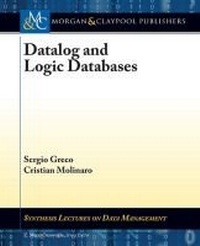
Datalog and Logic Databases
Published on 30. November 2015
Book
Paperback/Softback
169 pages
978-1-62705-113-2 (ISBN)
Description
The use of logic in databases started in the late 1960s. In the early 1970s Codd formalized databases in terms of the relational calculus and the relational algebra. A major influence on the use of logic in databases was the development of the field of logic programming. Logic provides a convenient formalism for studying classical database problems and has the important property of being declarative, that is, it allows one to express what she wants rather than how to get it.
For a long time, relational calculus and algebra were considered the relational database languages. However, there are simple operations, such as computing the transitive closure of a graph, which cannot be expressed with these languages. Datalog is a declarative query language for relational databases based on the logic programming paradigm. One of the peculiarities that distinguishes Datalog from query languages like relational algebra and calculus is recursion, which gives Datalog the capability to express queries like computing a graph transitive closure.
Recent years have witnessed a revival of interest in Datalog in a variety of emerging application domains such as data integration, information extraction, networking, program analysis, security, cloud computing, ontology reasoning, and many others. The aim of this book is to present the basics of Datalog, some of its extensions, and recent applications to different domains.
For a long time, relational calculus and algebra were considered the relational database languages. However, there are simple operations, such as computing the transitive closure of a graph, which cannot be expressed with these languages. Datalog is a declarative query language for relational databases based on the logic programming paradigm. One of the peculiarities that distinguishes Datalog from query languages like relational algebra and calculus is recursion, which gives Datalog the capability to express queries like computing a graph transitive closure.
Recent years have witnessed a revival of interest in Datalog in a variety of emerging application domains such as data integration, information extraction, networking, program analysis, security, cloud computing, ontology reasoning, and many others. The aim of this book is to present the basics of Datalog, some of its extensions, and recent applications to different domains.
More details
Series
Language
English
Place of publication
San Rafael, CA
United States
Publishing group
Morgan & Claypool Publishers
Dimensions
Height: 235 mm
Width: 187 mm
Weight
333 gr
ISBN-13
978-1-62705-113-2 (9781627051132)
Copyright in bibliographic data and cover images is held by Nielsen Book Services Limited or by the publishers or by their respective licensors: all rights reserved.
Schweitzer Classification
Content
- Acknowledgments
- Introduction
- Logic and Relational Databases
- Datalog
- Negation
- Function Symbols
- Aggregates
- Query Optimization
- Applications
- Bibliography
- Authors' Biographies
- Introduction
- Logic and Relational Databases
- Datalog
- Negation
- Function Symbols
- Aggregates
- Query Optimization
- Applications
- Bibliography
- Authors' Biographies