

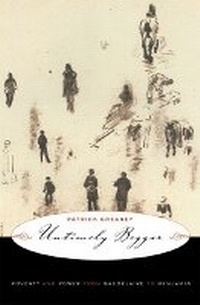
Untimely Beggar
Poverty and Power from Baudelaire to Benjamin
Will be published approx. on 24. December 2007
Book
Paperback/Softback
240 pages
978-0-8166-4951-8 (ISBN)
Description
This highly original book takes as its starting point a central question for nineteenth- and twentieth-century literature and philosophy: how to represent the poor?
Covering the period from the publication of Les Fleurs du Mal in 1857 to the composition of Benjamin's final texts in the 1930s, Untimely Beggar investigates the coincidence of two modern literary and philosophical interests: representing the poor and representing potential. To take account of literature's relation to the poor, Patrick Greaney proposes the concept of impoverished writing, which withdraws from representing objects and registers the existence of power. By reducing itself to the indication of its own potential, by impoverishing itself, literary language attempts to engage and participate in the power of the poor.
This focus on impoverished language offers new perspectives on major French and German authors, including Marx, Nietzsche, MallarmE, Rilke, and Brecht; and makes significant contributions to recent debates about power and potential in thinkers such as Agamben, Deleuze, Foucault, Hardt, and Negri. In doing so, Greaney offers significant insights into modernity's intense philosophical and literary interest in socioeconomic poverty.
Patrick Greaney is assistant professor of German studies at the University of Colorado, Boulder.
Covering the period from the publication of Les Fleurs du Mal in 1857 to the composition of Benjamin's final texts in the 1930s, Untimely Beggar investigates the coincidence of two modern literary and philosophical interests: representing the poor and representing potential. To take account of literature's relation to the poor, Patrick Greaney proposes the concept of impoverished writing, which withdraws from representing objects and registers the existence of power. By reducing itself to the indication of its own potential, by impoverishing itself, literary language attempts to engage and participate in the power of the poor.
This focus on impoverished language offers new perspectives on major French and German authors, including Marx, Nietzsche, MallarmE, Rilke, and Brecht; and makes significant contributions to recent debates about power and potential in thinkers such as Agamben, Deleuze, Foucault, Hardt, and Negri. In doing so, Greaney offers significant insights into modernity's intense philosophical and literary interest in socioeconomic poverty.
Patrick Greaney is assistant professor of German studies at the University of Colorado, Boulder.
More details
Language
English
Place of publication
Minnesota
United States
Dimensions
Height: 229 mm
Width: 149 mm
Thickness: 15 mm
ISBN-13
978-0-8166-4951-8 (9780816649518)
Copyright in bibliographic data and cover images is held by Nielsen Book Services Limited or by the publishers or by their respective licensors: all rights reserved.
Schweitzer Classification