

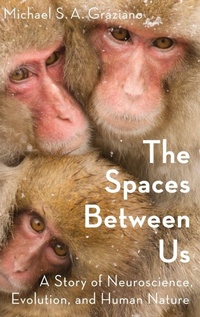
The Spaces Between Us
A Story of Neuroscience, Evolution, and Human Nature
Published on 5. April 2018
Book
Hardback
216 pages
978-0-19-046101-0 (ISBN)
Description
Each of us has a protected zone two or three feet wide, swelling around the head and narrowing towards the feet. This zone isn't fixed in size: if you're nervous, it grows; if you're relaxed, it shrinks. It also depends on your cultural upbringing. Personal space is small in Japan and large in Australia. This safety zone, called personal space, provides an invisible spatial scaffold that frames our social interactions.
As Michael Graziano argues in The Spaces Between Us, it also organizes our social and emotional spacing, influences our facial expressions, and shapes our interactions with everyday objects including tools, furniture, and clothing. Even ordinary actions like walking are informed by a continuous under-the-surface calculation of threats and obstacles around the body: what Graziano calls a virtual bubble-wrap of active neurons that fire and move us to action, even before we may be conscious of our course corrections in real time. Humans evolved a complex way of interacting with others and their environment, and The Spaces Between Us looks at how this infrastructure may have led to the first smile and to a host of other human activities, from tool use, to courtship, and to a sense of self. The book concludes with a case study of Graziano's son, who had heart-breaking difficulties developing a functioning personal space. Written with poignant narrative clarity, Graziano makes the case for the interested scientific public that this system in the brain is more than a fascinating scientific topic: it's deeply personal and shapes our human nature.
As Michael Graziano argues in The Spaces Between Us, it also organizes our social and emotional spacing, influences our facial expressions, and shapes our interactions with everyday objects including tools, furniture, and clothing. Even ordinary actions like walking are informed by a continuous under-the-surface calculation of threats and obstacles around the body: what Graziano calls a virtual bubble-wrap of active neurons that fire and move us to action, even before we may be conscious of our course corrections in real time. Humans evolved a complex way of interacting with others and their environment, and The Spaces Between Us looks at how this infrastructure may have led to the first smile and to a host of other human activities, from tool use, to courtship, and to a sense of self. The book concludes with a case study of Graziano's son, who had heart-breaking difficulties developing a functioning personal space. Written with poignant narrative clarity, Graziano makes the case for the interested scientific public that this system in the brain is more than a fascinating scientific topic: it's deeply personal and shapes our human nature.
Reviews / Votes
"The Spaces Between Us is a sparkling example of popular science-writing, mainly on the strength of Graziano's smart but affable teaching ability. The range of his curiosity about everything from the minute discriminations of laughter to the mysteries of the 'hand blink' reflex is inherently inviting, and the result is a book that will have readers questioning their every tiny twitch and shrug." --Open Letters MonthlyMore details
Language
English
Place of publication
New York
United States
Target group
Professional and scholarly
College/higher education
Illustrations
12
Dimensions
Height: 240 mm
Width: 161 mm
Thickness: 16 mm
Weight
493 gr
ISBN-13
978-0-19-046101-0 (9780190461010)
Copyright in bibliographic data and cover images is held by Nielsen Book Services Limited or by the publishers or by their respective licensors: all rights reserved.
Schweitzer Classification
Other editions
Additional editions
E-Book
12/2017
1st Edition
OUP eBook
€9.99
Available for download
E-Book
12/2017
1st Edition
OUP eBook
€9.99
Available for download
Person
Michael S. A. Graziano is a professor of neuroscience at Princeton University. He is an internationally renowned scientist and an award winning novelist. For thirty years he has studied the brain basis of movement control, personal space, and conscious experience. He is also a science columnist, writing for the New York Times, The Atlantic, and other magazines.
Content
A Note On Terminology Chapter 1: The Second Skin Chapter 2: A Startling Discovery Chapter 3: The Flight Zone of the Zebra Chapter 4: The French Stare Too Much and My Lover Has A Bulgy Nose Chapter 5: Monkey Versus Ping Pong Ball Chapter 6: Kissing in the Dark Chapter 7: Hand-2-Mouth and Other Shocking Surprises of the Motor Cortex Chapter 8: Superflinchers and Nerves of Steel Chapter 9: The Peripersonal Radar In Humans Chapter 10: Wrapping Personal Space Around My Black & Decker Chapter 11: Why It's Sexy To Let A Vampire Bite Your Neck, And Other Social Consequences of Peripersonal Space Chapter 12: The First Smile Chapter 13: The First Laugh Chapter 14: The First Cry Chapter 15: The Personal Dimension of Personal Space