

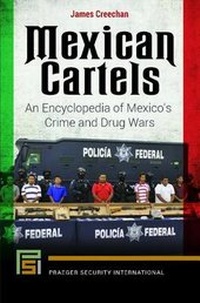
Mexican Cartels
An Encyclopedia of Mexico's Crime and Drug Wars
Published on 31. January 2019
Book
Hardback
420 pages
978-1-4408-3291-8 (ISBN)
Description
This book presents the necessary facts to explain the phenomenon of drug cartels and social violence in Mexico-and to understand why the deeply ingrained drug trade cannot easily be eliminated using only a policy of military force.
The drug trade in Mexico is deeply ingrained in the social organization of the country's institutions. It is promoted and encouraged by decades of widespread acceptance and tolerance of corruption, and it flourishes in part as a result of the lack of respect for human rights and the rule of law. This book presents a comprehensive overview of all cartel-based drug trade activity throughout Mexico, describing the intertwined cultural, political, and economic themes to enable readers to understand the foundation of drug cartels in Mexico. A significant number of the informative essays describe facts and details that have never been previously available to an English-language readership.
Mexican Cartels: An Encyclopedia of Mexico's Crime and Drug War is organized around five broad themes, each being addressed in a section containing detailed, alphabetically arranged entries. The sections address the key cartels and their linkages, identify key players in the transnational organizations, describe government and institutional agencies charged with monitoring and responding to the cartels, examine the context and contingencies of the drug trade such as geography and drug routes, and highlight the cultural, economic, and political expressions in support of criminal activity. Readers will come away with an understanding of how the drug trade and violence in Mexico continues as a consequence of global economic forces, corrupt and inefficient institutions, geographical accident, socio-demographic trends, cultural values, and a commitment to a hard-line model of a war on drugs, not because of any natural inclination towards criminal culture among the individuals involved.
* Examines the deeper socio-economic links and the political-criminal cooperation that explains the complex roots of the Mexican drug cartel problem rather than focusing on simplistic identification of criminal motivation and individual crime lords
* Documents how the ongoing emphasis on criminal personalities and policies that focus on eliminating key crime bosses has resulted in a failed drug war
* Serves as a highly useful resource for political scientists, sociologists, journalists, and NGO representatives focused on Latin America as well as for anyone working along the American Mexican border or dealing with issues of trade, migration, and security
The drug trade in Mexico is deeply ingrained in the social organization of the country's institutions. It is promoted and encouraged by decades of widespread acceptance and tolerance of corruption, and it flourishes in part as a result of the lack of respect for human rights and the rule of law. This book presents a comprehensive overview of all cartel-based drug trade activity throughout Mexico, describing the intertwined cultural, political, and economic themes to enable readers to understand the foundation of drug cartels in Mexico. A significant number of the informative essays describe facts and details that have never been previously available to an English-language readership.
Mexican Cartels: An Encyclopedia of Mexico's Crime and Drug War is organized around five broad themes, each being addressed in a section containing detailed, alphabetically arranged entries. The sections address the key cartels and their linkages, identify key players in the transnational organizations, describe government and institutional agencies charged with monitoring and responding to the cartels, examine the context and contingencies of the drug trade such as geography and drug routes, and highlight the cultural, economic, and political expressions in support of criminal activity. Readers will come away with an understanding of how the drug trade and violence in Mexico continues as a consequence of global economic forces, corrupt and inefficient institutions, geographical accident, socio-demographic trends, cultural values, and a commitment to a hard-line model of a war on drugs, not because of any natural inclination towards criminal culture among the individuals involved.
* Examines the deeper socio-economic links and the political-criminal cooperation that explains the complex roots of the Mexican drug cartel problem rather than focusing on simplistic identification of criminal motivation and individual crime lords
* Documents how the ongoing emphasis on criminal personalities and policies that focus on eliminating key crime bosses has resulted in a failed drug war
* Serves as a highly useful resource for political scientists, sociologists, journalists, and NGO representatives focused on Latin America as well as for anyone working along the American Mexican border or dealing with issues of trade, migration, and security
More details
Series
Language
English
Place of publication
United States
Publishing group
Bloomsbury Publishing Plc
Target group
College/higher education
Professional and scholarly
ISBN-13
978-1-4408-3291-8 (9781440832918)
Copyright in bibliographic data and cover images is held by Nielsen Book Services Limited or by the publishers or by their respective licensors: all rights reserved.
Schweitzer Classification
Persons
James Creechan, PhD, is a retired professor of sociology. He was a tenured professor of sociology at the University of Alberta, Edmonton, Canada.