

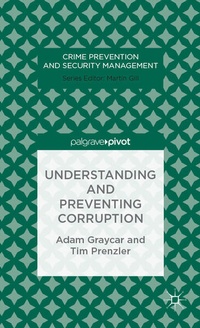
Understanding and Preventing Corruption
Published on 4. November 2013
Book
Hardback
X, 161 pages
978-1-137-33508-1 (ISBN)
Description
Graycar and Prenzler present a readily accessible guide to the issues of public and private sector corruption, outlining the nature and dimensions of corruption problems in a variety of settings across the world, and providing a set of practical strategies to prevent corruption that also facilitate economic growth and development.
More details
Series
Edition
2013 edition
Language
English
Place of publication
London
United Kingdom
Target group
Professional and scholarly
Product notice
sewn/stitched
Cloth over boards
With dust jacket
Illustrations
X, 161 p.
Dimensions
Height: 216 mm
Width: 140 mm
Thickness: 14 mm
Weight
367 gr
ISBN-13
978-1-137-33508-1 (9781137335081)
DOI
10.1057/9781137335098
Schweitzer Classification
Other editions
Additional editions
A. Graycar | T. Prenzler
Understanding and Preventing Corruption
E-Book
11/2013
Palgrave Pivot
€64.19
Available for download
A. Graycar | T. Prenzler
Understanding and Preventing Corruption
Book
01/2013
Palgrave Pivot
€48.14
Article exhausted; check different version
Persons
Adam Graycar is Professor of Public Policy and Director of the Transnational Research Institute on Corruption at the Australian National University, Australia. He has also served as Dean of the School of Criminal Justice at Rutgers University, USA and Director of the Australian Institute of Criminology in Canberra.
Tim Prenzler is a Professor in the Australian Research Council Centre of Excellence in Policing and Security (CEPS) and the School of Criminology and Criminal Justice at Griffith University Brisbane, Australia. In CEPS he manages the Integrity Systems Project and works in the Frontline Policing Project.
Tim Prenzler is a Professor in the Australian Research Council Centre of Excellence in Policing and Security (CEPS) and the School of Criminology and Criminal Justice at Griffith University Brisbane, Australia. In CEPS he manages the Integrity Systems Project and works in the Frontline Policing Project.
Content
Part I: CORRUPTION IS COMPLEX 1. Describing Corruption 2. Understanding Corruption 3. Measuring Corruption Part II: DESIGNING COUNTER-MEASURES 4. The Architecture of Corruption Control 5. Applying Crime Prevention and Regulatory Theory to Corruption Part III: COMBATING AND REDUCING CORRUPTION 6. Preventing Corruption in Criminal Justice 7. Preventing Corruption in Public Sector Procurement 8. Preventing Corruption in Public Health 9. Designing out Corruption in Urban Planning