

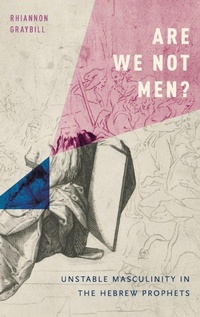
Are We Not Men?
Unstable Masculinity in the Hebrew Prophets
Published on 26. January 2017
Book
Hardback
200 pages
978-0-19-022736-4 (ISBN)
Description
Are We Not Men? offers an innovative approach to gender and embodiment in the Hebrew Bible, revealing the male body as a source of persistent difficulty for the Hebrew prophets. Drawing together key moments in prophetic embodiment, Graybill demonstrates that the prophetic body is a queer body, and its very instability makes possible new understandings of biblical masculinity. Prophecy disrupts the performance of masculinity and demands new ways of inhabiting the body and negotiating gender.
Graybill explores prophetic masculinity through critical readings of a number of prophetic bodies, including Isaiah, Moses, Hosea, Jeremiah, and Ezekiel. In addition to close readings of the biblical texts, this account engages with modern intertexts drawn from philosophy, psychoanalysis, and horror films: Isaiah meets the poetry of Anne Carson; Hosea is seen through the lens of possession films and feminist film theory; Jeremiah intersects with psychoanalytic discourses of hysteria; and Ezekiel encounters Daniel Paul Schreber's Memoirs of My Nervous Illness. Graybill also offers a careful analysis of the body of Moses. Her methods highlight unexpected features of the biblical texts, and illuminate the peculiar intersections of masculinity, prophecy, and the body in and beyond the Hebrew Bible. This assembly of prophets, bodies, and readings makes clear that attending to prophecy and to prophetic masculinity is an important task for queer reading. Biblical prophecy engenders new forms of masculinity and embodiment; Are We Not Men?offers a valuable map of this still-uncharted terrain.
Graybill explores prophetic masculinity through critical readings of a number of prophetic bodies, including Isaiah, Moses, Hosea, Jeremiah, and Ezekiel. In addition to close readings of the biblical texts, this account engages with modern intertexts drawn from philosophy, psychoanalysis, and horror films: Isaiah meets the poetry of Anne Carson; Hosea is seen through the lens of possession films and feminist film theory; Jeremiah intersects with psychoanalytic discourses of hysteria; and Ezekiel encounters Daniel Paul Schreber's Memoirs of My Nervous Illness. Graybill also offers a careful analysis of the body of Moses. Her methods highlight unexpected features of the biblical texts, and illuminate the peculiar intersections of masculinity, prophecy, and the body in and beyond the Hebrew Bible. This assembly of prophets, bodies, and readings makes clear that attending to prophecy and to prophetic masculinity is an important task for queer reading. Biblical prophecy engenders new forms of masculinity and embodiment; Are We Not Men?offers a valuable map of this still-uncharted terrain.
Reviews / Votes
Her innovation is bringing the male prophetic body, not just prophetic words, under consideration. Graybill's methodological approach opens up new and exciting avenues. Considering the prophetic books alongside modern intertexts that draw from a variety of fields, from psychoanalysis to film, allows readers to discover new sides to the texts heretofore unexplored... As a whole, Are We Not Men? is a brilliant little book that should be required reading for any scholar of biblical masculinity and queer studies. * Sarah E.G. Fein, Ancient Jew Review *More details
Language
English
Place of publication
New York
United States
Target group
College/higher education
Professional and scholarly
Dimensions
Height: 240 mm
Width: 161 mm
Thickness: 15 mm
Weight
470 gr
ISBN-13
978-0-19-022736-4 (9780190227364)
Copyright in bibliographic data and cover images is held by Nielsen Book Services Limited or by the publishers or by their respective licensors: all rights reserved.
Schweitzer Classification
Other editions
Additional editions
E-Book
11/2016
1st Edition
OUP eBook
€53.49
Available for download
E-Book
11/2016
1st Edition
OUP eBook
€41.49
Available for download
Person
Rhiannon Graybill is Assistant Professor of Religious Studies at Rhodes College in Memphis, TN. She holds a PhD in Near Eastern Studies from the University of California, Berkeley.
Content
Acknowledgements
Introduction
Chapter 1 The Materiality of Moses: The Prophet's Body in Trouble
Chapter 2 The Horror of Hosea: Female Bodies and Masculine Anxieties in Hosea 1-3
Chapter 3 The Hysteria of Jeremiah: Gender and Voice in the Confessions
Chapter 4 The Unmanning of Ezekiel: The Prophet's Body Voluptuous and Shattered in Ezekiel 1-5
Chapter 5 The Queer Prophetic Body
Chapter 6 Final Reflections
Bibliography
Introduction
Chapter 1 The Materiality of Moses: The Prophet's Body in Trouble
Chapter 2 The Horror of Hosea: Female Bodies and Masculine Anxieties in Hosea 1-3
Chapter 3 The Hysteria of Jeremiah: Gender and Voice in the Confessions
Chapter 4 The Unmanning of Ezekiel: The Prophet's Body Voluptuous and Shattered in Ezekiel 1-5
Chapter 5 The Queer Prophetic Body
Chapter 6 Final Reflections
Bibliography