

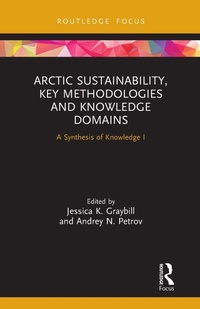
Arctic Sustainability, Key Methodologies and Knowledge Domains
A Synthesis of Knowledge I
1st Edition
Published on 13. December 2021
Book
Paperback/Softback
150 pages
978-1-032-23857-9 (ISBN)
Description
This book provides a first-ever synthesis of sustainability and sustainable development experiences in the Arctic. It presents state-of-the-art thinking about sustainability for the Arctic from a multi-disciplinary perspective.
This book aims to create a comprehensive, integrative knowledge base for the assessment of Arctic sustainability for countries such as the United States, Canada, Greenland, Iceland, Norway, Sweden, Finland, and Russia, alongside emerging ideas about sustainable development in the Arctic. These ideas relate to understanding how a community's geography matters in determining the required sustainability efforts, decolonial thinking for building sustainability that is crafted by and for local and Indigenous communities, and the idea of polycentrism (i.e., that the paths toward sustainability differ among places and communities). This volume also highlights the recent thinking about sustainability and resilience over the past decade for the rapidly changing Arctic region.
With patterns of thinking drawn from economic, social, environmental, community, and other components of sustainability; observations and monitoring; engagement of Indigenous knowledge; and integration with policy and decision making, the book helps us understand the complexity and interconnectedness of current Arctic transformations in a more comprehensive way.
This book aims to create a comprehensive, integrative knowledge base for the assessment of Arctic sustainability for countries such as the United States, Canada, Greenland, Iceland, Norway, Sweden, Finland, and Russia, alongside emerging ideas about sustainable development in the Arctic. These ideas relate to understanding how a community's geography matters in determining the required sustainability efforts, decolonial thinking for building sustainability that is crafted by and for local and Indigenous communities, and the idea of polycentrism (i.e., that the paths toward sustainability differ among places and communities). This volume also highlights the recent thinking about sustainability and resilience over the past decade for the rapidly changing Arctic region.
With patterns of thinking drawn from economic, social, environmental, community, and other components of sustainability; observations and monitoring; engagement of Indigenous knowledge; and integration with policy and decision making, the book helps us understand the complexity and interconnectedness of current Arctic transformations in a more comprehensive way.
More details
Series
Language
English
Place of publication
London
United Kingdom
Publishing group
Taylor & Francis Ltd
Target group
College/higher education
Postgraduate and Undergraduate
Illustrations
10 s/w Abbildungen
10 Illustrations, black and white
Dimensions
Height: 216 mm
Width: 140 mm
Thickness: 8 mm
Weight
201 gr
ISBN-13
978-1-032-23857-9 (9781032238579)
Copyright in bibliographic data and cover images is held by Nielsen Book Services Limited or by the publishers or by their respective licensors: all rights reserved.
Schweitzer Classification
Other editions
Additional editions
Jessica K. Graybill | Andrey N. Petrov
Arctic Sustainability, Key Methodologies and Knowledge Domains
A Synthesis of Knowledge I
Book
02/2020
1st Edition
Routledge
€76.90
Shipment within 15-20 days
Jessica K. Graybill | Andrey N. Petrov
Arctic Sustainability, Key Methodologies and Knowledge Domains
A Synthesis of Knowledge I
E-Book
02/2020
1st Edition
Routledge
€31.49
Available for download
Jessica K. Graybill | Andrey N. Petrov
Arctic Sustainability, Key Methodologies and Knowledge Domains
A Synthesis of Knowledge I
E-Book
02/2020
1st Edition
Routledge
€31.49
Available for download
Persons
Jessica K. Graybill is Associate Professor in the Department of Geography at Colgate University, Hamilton, New York. Her research interests include resilience studies and socio-ecological transformations in postsocialist, urban, and remote spaces and grappling with how environments, livelihoods, and possible futures are co-created by multiple actors.
Andrey N. Petrov is Associate Professor and Director of the ARCTICenter at the University of Northern Iowa. Dr. Petrov is an economic geographer who specializes in Arctic sustainable development, economic organization, and changing Arctic social-ecological systems. He is the president of the International Arctic Social Sciences Association.
Andrey N. Petrov is Associate Professor and Director of the ARCTICenter at the University of Northern Iowa. Dr. Petrov is an economic geographer who specializes in Arctic sustainable development, economic organization, and changing Arctic social-ecological systems. He is the president of the International Arctic Social Sciences Association.
Content
Preface 1. Introduction to Arctic Sustainability: A Synthesis of Knowledge Jessica K. Graybill and Andrey N. Petrov 2. Sustainable Economies in the Arctic Joan Nyman Larsen and Lee Huskey 3. Culture and Sustainability Susanna Gartler, Vera Kuklina and Peter Schweitzer 4. Sustainable Resources Chris Southcott 5. Governance for Arctic Sustainability Gary N. Wilson, Gail Fondahl and Klaus Georg Hansen 6. Methodological Challenges and Innovations in Arctic Community Sustainability Research Gary Kofinas, Shauna BurnSilver and Andrey N. Petrov Afterword: In Anticipation of Arctic Sustainability, Community and Environment: A Synthesis of Knowledge II Andrey N. Petrov, Jessica K. Graybill, Tatiana Degai, Aileen A. Espiritu, Diane Hirshberg and Tatiana Vlasova