

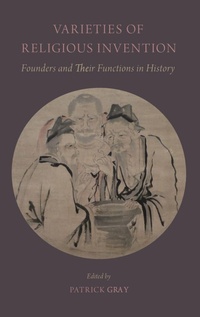
Varieties of Religious Invention
Founders and Their Functions in History
Published on 1. October 2015
Book
Hardback
224 pages
978-0-19-935971-4 (ISBN)
Description
Religious controversies frequently center on origins, and at the origins of the major religious traditions one typically finds a seminal figure. Names such as Jesus, Muhammad, Confucius, and Moses are well known, yet their status as "founders" has not gone uncontested. Does Paul deserve the credit for founding Christianity? Is Laozi the father of Daoism, or should that title belong to Zhuangzi? What is at stake, if anything, in debates about "the historical Buddha"?
What assumptions are implicit in the claim that Hinduism is a religion without a founder? The essays in Varieties of Religious Invention do not attempt to settle these perennial arguments once and for all. Rather, they aim to consider the subtexts of such debates as an exercise in comparative
religion: Who engages in them? To whom do they matter, and when? When is "development" in a religious tradition perceived as "deviation" from its roots? To what extent are origins thought to define the "essence" of a religion? In what ways do arguments about founders serve as a proxy for broader cultural, theological, political, or ideological questions? What do they reveal about the ways in which the past is remembered and authority negotiated?
As the contributors survey the landscape shaped by these questions within each tradition, they provide insights and novel perspectives about the religions individually, and about the study of world religions as a whole.
What assumptions are implicit in the claim that Hinduism is a religion without a founder? The essays in Varieties of Religious Invention do not attempt to settle these perennial arguments once and for all. Rather, they aim to consider the subtexts of such debates as an exercise in comparative
religion: Who engages in them? To whom do they matter, and when? When is "development" in a religious tradition perceived as "deviation" from its roots? To what extent are origins thought to define the "essence" of a religion? In what ways do arguments about founders serve as a proxy for broader cultural, theological, political, or ideological questions? What do they reveal about the ways in which the past is remembered and authority negotiated?
As the contributors survey the landscape shaped by these questions within each tradition, they provide insights and novel perspectives about the religions individually, and about the study of world religions as a whole.
Reviews / Votes
"By examining the 'founders' of various religious traditions, this book helps us to better understand both those individual traditions and the connections between them. It is an especially useful resource for those who are interested in comparative theology." --Amir Hussain, Professor of Theological Studies, Loyola Marymount UniversityMore details
Other editions
Additional editions
Book
10/2015
Oxford University Press Inc
€50.70
Shipment within 15-20 days
E-Book
09/2015
1st Edition
OUP eBook
€16.49
Available for download
E-Book
09/2015
1st Edition
OUP eBook
€19.99
Available for download
Person
Patrick Gray is Associate Professor of Religious Studies at Rhodes College in Memphis, Tennessee. He has published five books on the Bible, the history of biblical interpretation, and Hellenistic philosophy, including Opening Paul's Letters: A Reader's Guide to Genre and Interpretation.
Content
Contributors ; Abbreviations ; Introduction ; Patrick Gray ; Chapter 1) Finding Judaism's Founders ; Mark Leuchter ; Chapter 2) The Buddha: Historicizing Myth, Mythologizing History ; Nathan McGovern ; Chapter 3) When the Founder is Not a Creator: Confucius and Confucianism Reconsidered ; Cai Liang ; Chapter 4) What is Daoism and Who is Its Founder? ; Gil Raz ; Chapter 5) Jesus, Paul, and the Birth of Christianity ; Patrick Gray ; Chapter 6) Muhammad's Mission and the Din of Ibrahim according to Ibn Ishaq ; R. Kevin Jaques ; Chapter 7) Hinduism and the Question of Founders ; Mans Broo ; Chapter 8) Crossing Boundaries: When Founders of Faith Appear in Other Traditions ; Mark Muesse ; Index