

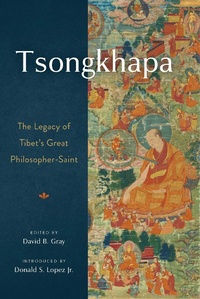
Tsongkhapa
The Legacy of Tibet's Great Philosopher-Saint
Published on 22. November 2024
Book
Paperback/Softback
264 pages
978-1-61429-755-0 (ISBN)
Description
Tsongkhapa’s seminal contributions to Buddhist thought and practice, and to the course of history, are illuminated and celebrated by some of his foremost modern interpreters.
Few figures have impacted the trajectory of Buddhism as much as the great philosopher and meditator, scholar and reformer, Tsongkhapa Losang Drakpa (1357–1419), the founder of the Geluk school of Tibetan Buddhism and teacher of the First Dalai Lama. His Ganden tradition spread throughout Central Asia and Mongolia, and today, through figures such as the Dalai Lama, who calls Tsongkhapa a second Nagarjuna, his teachings are shaping intellectual conversations and ethical practice globally. To commemorate the 600th anniversary of Tsongkhapa’s passing, a special conference was held at Ganden Monastery in India in 2019, featuring some of the best translators and interpreters of his teachings today. Highlights of those incisive summations of Tsongkhapa’s special contributions are gathered in this volume. Here we discover Tsongkhapa the philosopher, Tsongkhapa the master of the Buddhist canon, Tsongkhapa the tantric adept, and Tsongkhapa as the visionary who united wisdom to compassion.
Each of the authors featured looks at a distinct facet of Tsongkhapa’s legacy. Donald Lopez provides a global context, Guy Newland distills Tsongkhapa’s Middle Way, Dechen Rochard uncovers the identity view, Jay Garfield examines the conceptualized ultimate, Thupten Jinpa highlights the seminal importance Tsongkhapa placed on ascertainment, David Gray looks at his approach to Cakrasamvara tantra, Gavin Kilty surveys his Guhyasamaja tantra commentary, Roger Jackson surmises his views on Zen and mahamudra, Geshé Ngawang Samten examines his provisional-definitive distinction, Gareth Sparham highlights his scholastic prowess, Mishig-Ish Bataa illuminates his impact in Mongolia, and Bhiksuni Thubten Chodron presents his instructions on how to cultivate compassion.
Whether you are well acquainted with Tsongkhapa’s life and thought or you are encountering him here for the first time, you will find The Legacy of Tsongkhapa an illuminating survey of his unique explorations of the highest aspirations of humanity.
Few figures have impacted the trajectory of Buddhism as much as the great philosopher and meditator, scholar and reformer, Tsongkhapa Losang Drakpa (1357–1419), the founder of the Geluk school of Tibetan Buddhism and teacher of the First Dalai Lama. His Ganden tradition spread throughout Central Asia and Mongolia, and today, through figures such as the Dalai Lama, who calls Tsongkhapa a second Nagarjuna, his teachings are shaping intellectual conversations and ethical practice globally. To commemorate the 600th anniversary of Tsongkhapa’s passing, a special conference was held at Ganden Monastery in India in 2019, featuring some of the best translators and interpreters of his teachings today. Highlights of those incisive summations of Tsongkhapa’s special contributions are gathered in this volume. Here we discover Tsongkhapa the philosopher, Tsongkhapa the master of the Buddhist canon, Tsongkhapa the tantric adept, and Tsongkhapa as the visionary who united wisdom to compassion.
Each of the authors featured looks at a distinct facet of Tsongkhapa’s legacy. Donald Lopez provides a global context, Guy Newland distills Tsongkhapa’s Middle Way, Dechen Rochard uncovers the identity view, Jay Garfield examines the conceptualized ultimate, Thupten Jinpa highlights the seminal importance Tsongkhapa placed on ascertainment, David Gray looks at his approach to Cakrasamvara tantra, Gavin Kilty surveys his Guhyasamaja tantra commentary, Roger Jackson surmises his views on Zen and mahamudra, Geshé Ngawang Samten examines his provisional-definitive distinction, Gareth Sparham highlights his scholastic prowess, Mishig-Ish Bataa illuminates his impact in Mongolia, and Bhiksuni Thubten Chodron presents his instructions on how to cultivate compassion.
Whether you are well acquainted with Tsongkhapa’s life and thought or you are encountering him here for the first time, you will find The Legacy of Tsongkhapa an illuminating survey of his unique explorations of the highest aspirations of humanity.
More details
Language
English
Place of publication
Somerville
United States
Product notice
Paperback (trade)
Unsewn / adhesive bound
Dimensions
Height: 224 mm
Width: 151 mm
Thickness: 20 mm
Weight
408 gr
ISBN-13
978-1-61429-755-0 (9781614297550)
Copyright in bibliographic data and cover images is held by Nielsen Book Services Limited or by the publishers or by their respective licensors: all rights reserved.
Schweitzer Classification
Other editions
Additional editions
E-Book
10/2024
Simon + Schuster LLC
€25.70
Available for download
Person
David B. Gray is Bernard J. Hanley Professor of Religious Studies at Santa Clara University, in Santa Clara, California, where he teaches a wide range of courses on Asian religions. His research explores the development of tantric Buddhist traditions in South Asia and their dissemination in Tibet and East Asia, with a focus on yoginitantra, a genre of Buddhist literature focused on female deities and yogic practices involving the subtle body. His publications include numerous articles and book chapters, an edited volume, as well as The Cakrasamvara Tantra: A Study and Annotated Translation (2007), The Cakrasamvara Tantra: Editions of the Sanskrit and Tibetan Texts Translation (2012), Illumination of the Hidden Meaning (Chapters 1–24): Mandala, Mantra, and the Cult of the Yoginis (2017) and Illumination of the Hidden Meaning, Part II: Chapters 25–51, Yogic Vows, Conduct, and Ritual Practice (2019).
Donald Lopez is an Arthur E. Link Distinguished University Professor of Buddhist and Tibetan Studies in the Department of Asian Languages and Cultures at the University of Michigan. He is the author of numerous monographs, translations, and edited volumes on South Asian Buddhism, Tibetan Buddhism, and the European encounter with Buddhism. In 2014 his Princeton Dictionary of Buddhism (with Robert Buswell) was awarded the Dartmouth Medal of the American Library Association for best reference work of the year. In 2000 he was elected to the American Academy of Arts and Sciences.
Donald Lopez is an Arthur E. Link Distinguished University Professor of Buddhist and Tibetan Studies in the Department of Asian Languages and Cultures at the University of Michigan. He is the author of numerous monographs, translations, and edited volumes on South Asian Buddhism, Tibetan Buddhism, and the European encounter with Buddhism. In 2014 his Princeton Dictionary of Buddhism (with Robert Buswell) was awarded the Dartmouth Medal of the American Library Association for best reference work of the year. In 2000 he was elected to the American Academy of Arts and Sciences.