

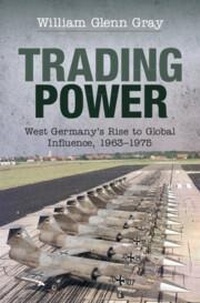
Trading Power
West Germany's Rise to Global Influence, 1963-1975
Published on 3. November 2022
Book
Hardback
475 pages
978-1-108-42464-6 (ISBN)
Description
Trading Power traces the successes and failures of a generation of German political leaders as the Bonn Republic emerged as a substantial force in European, Atlantic, and world affairs. Over the course of the 1960s and 1970s, West Germans relinquished many trappings of hard power, most notably nuclear weapons, and learned to leverage their economic power instead. Obsessed with stability and growth, Bonn governments battled inflation in ways that enhanced the international position of the Deutsche Mark while upending the international monetary system. Germany's remarkable export achievements exerted a strong hold on the Soviet bloc, forming the basis for a new Ostpolitik under Willy Brandt. Through much trial and error, the Federal Republic learned how to find a balance among key Western allies, and in the mid-1970s Helmut Schmidt ensured Germany's centrality to institutions such as the European Council and the G-7 - the newly emergent leadership structures of the West.
Reviews / Votes
'Trading Power is the single best and most complete analysis of West Germany's rise to dominance in cold war Europe. Based on extraordinarily in-depth research, Gray skillfully and clearly tells the story of the diplomatic, political, and economic development of German power within the European community, the Atlantic alliance, and the international system. This history is essential to understanding Germany's significance in shaping the liberal world order and its changing position in today's Europe. It is a must-read for policymakers and students alike. A real triumph!' Thomas A. Schwartz, author of Henry Kissinger and American Power: A Political Biography 'This is a formidable book and one that promises to make an impact.' Nick Ostrum, Europe Now Journal 'The book is supported by sources and facts in the most pleasing way and resists the trend towards theorizing in cultural studies. It will be the benchmark for interpretations of West German foreign policy for a very long time, far beyond the narrower twelve-year period under study.' Jan-Otmar Hesse, H-Soz-Kult 'Readers will appreciate the intricate analysis of a unique foreign policy path facing multiple challenges from terrorism to the first oil shock. ... Recommended.' G. P. de Syon, Choice 'Gray's style is always closely oriented to the sources, which enables him to innovatively capture some facets of Bonn's interwoven national politics and its orientation in the world. He does not shy away from clear, and above all critical, statements and labels, which are also fed by internal US or French sources. This makes the book a stimulating and innovative read. The reconstruction of the struggles of everyday political work in the cabinet and in major politics, sometimes supplemented by the eagle eye of global classification, represent the central achievements of an important volume.' Jost Duelffer, SehepunkteMore details
Language
English
Place of publication
Cambridge
United Kingdom
Product notice
sewn/stitched
Cloth over boards
Illustrations
Worked examples or Exercises
Dimensions
Height: 232 mm
Width: 159 mm
Thickness: 37 mm
Weight
860 gr
ISBN-13
978-1-108-42464-6 (9781108424646)
Copyright in bibliographic data and cover images is held by Nielsen Book Services Limited or by the publishers or by their respective licensors: all rights reserved.
Schweitzer Classification
Other editions
Additional editions
Book
05/2024
Cambridge University Press
€32.50
Shipment within 15-20 days
E-Book
11/2022
Cambridge University Press
€31.99
Available for download
E-Book
10/2022
Cambridge University Press
€31.99
Available for download
Person
William Glenn Gray is Associate Professor of History at Purdue University. He is the author of Germany's Cold War: The Global Campaign to Isolate East Germany, 1949-1969 (2003). In 2015, he was awarded the DAAD Prize for Distinguished Scholarship in German and European Studies.
Content
Introduction; 1. The unraveling of Adenauer's grand strategy (1962-1963); 2. America's junior partner (1963-1964); 3. Twenty years after (1964-1965); 4. The stability imperative (1965-1966); 5. Gaullist temptations (1966-1968); 6. The magnetism of prosperity (1967-1968); 7. A decisive election (1969); 8. The zenith of Ostpolitik (1970); 9. The European pendulum (1970-1972); 10. Hazards from the Global South (1970-1972); 11. The embattled chancellor (1971-1972); 12. The center of Europe (1973); 13. The crisis management team (1973-1974); 14. New structures for the West (1974-75); Conclusion; Select bibliography; Index.