

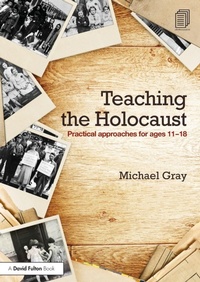
Teaching the Holocaust
Practical approaches for ages 11-18
1st Edition
Published on 18. May 2015
Book
Paperback/Softback
208 pages
978-1-138-79100-8 (ISBN)
Description
Teaching the Holocaust is an important but often challenging task for those involved in modern Holocaust education. What content should be included and what should be left out? How can film and literature be integrated into the curriculum? What is the best way to respond to students who resist the idea of learning about it?
This book, drawing upon the latest research in the field, offers practical help and advice on delivering inclusive and engaging lessons along with guidance on how to navigate through the many controversies and considerations when planning, preparing, and delivering Holocaust education. Whether teaching the subject in History, Religious Education, English or even in a school assembly, there is a wealth of wisdom which will make the task easier for you and make the learning experience more beneficial for the student.
Chapters include:
The aims of Holocaust education
Ethical issues to consider when teaching the Holocaust
Using film and documentaries in the classroom
Teaching the Holocaust through literature
The role of online learning and social media
The benefits and practicalities of visiting memorial sites
With lesson plans, resources, and schemes of work which can be used across a range of different subjects, this book is essential reading for those that want to deepen their understanding and deliver effective, thought-provoking Holocaust education.
This book, drawing upon the latest research in the field, offers practical help and advice on delivering inclusive and engaging lessons along with guidance on how to navigate through the many controversies and considerations when planning, preparing, and delivering Holocaust education. Whether teaching the subject in History, Religious Education, English or even in a school assembly, there is a wealth of wisdom which will make the task easier for you and make the learning experience more beneficial for the student.
Chapters include:
The aims of Holocaust education
Ethical issues to consider when teaching the Holocaust
Using film and documentaries in the classroom
Teaching the Holocaust through literature
The role of online learning and social media
The benefits and practicalities of visiting memorial sites
With lesson plans, resources, and schemes of work which can be used across a range of different subjects, this book is essential reading for those that want to deepen their understanding and deliver effective, thought-provoking Holocaust education.
More details
Language
English
Place of publication
London
United Kingdom
Publishing group
Taylor & Francis Ltd
Target group
College/higher education
Professional and scholarly
Postgraduate, Professional, Professional Practice & Development, and Undergraduate
Product notice
Paperback (trade)
Unsewn / adhesive bound
Illustrations
7 s/w Abbildungen, 1 s/w Photographie bzw. Rasterbild, 6 s/w Zeichnungen, 16 s/w Tabellen
16 Tables, black and white; 6 Line drawings, black and white; 1 Halftones, black and white; 7 Illustrations, black and white
Dimensions
Height: 246 mm
Width: 172 mm
Thickness: 15 mm
Weight
405 gr
ISBN-13
978-1-138-79100-8 (9781138791008)
Copyright in bibliographic data and cover images is held by Nielsen Book Services Limited or by the publishers or by their respective licensors: all rights reserved.
Schweitzer Classification
Other editions
Additional editions
Book
05/2015
1st Edition
Routledge
€193.50
Shipment within 10-20 days
E-Book
05/2015
Routledge
€45.99
Available for download
E-Book
05/2015
Routledge
€45.99
Available for download
Person
Michael Gray teaches at Harrow School, UK. He has a Ph.D. in Holocaust education and has published widely on the subject. He is a member of both the International Network of Genocide Scholars and the British Association of Holocaust Studies.
Content
1. What was the Holocaust? 2. Why teach about the Holocaust? 3. How should the Holocaust be taught? 4. What do students already know? 5. Using film in the classroom 6. Using literature in the classroom 7. Digital learning and new technologies 8. Visiting Holocaust sites 9. Comparing the Holocaust to other Genocides 10. Teaching in a multicultural society 11. Combatting Antisemitism 12. Dealing with Holocaust denial and distortion 13. Schemes of work 14. Lesson Plans 15. Teaching resources