

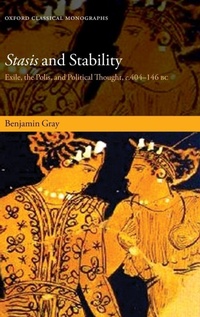
Stasis and Stability
Exile, the Polis, and Political Thought, c. 404-146 BC
Published on 20. August 2015
Book
Hardback
468 pages
978-0-19-872977-8 (ISBN)
Description
The continued vitality of the Greek city (polis) in the centuries after the Peloponnesian War has now been richly demonstrated by historians. But how does that vitality relate to the prominence in the same period of both civic unrest, or stasis, and utopian political thinking? In order to address this question, this volume uses exile and exiles as a lens for investigating the later Classical and Hellenistic polis and the political ideas which shaped it. The issue of the political and ethical status of exile and exiles necessarily raised fundamental questions about civic inclusion and exclusion, closely bound up with basic ideas of justice, virtue, and community. This makes it possible to interpret the varied evidence for exile as a guide to the complex, dynamic ecology of political ideas within the later Classical and post-Classical civic world, including both taken-for-granted political assumptions and more developed political ideologies and philosophies.
In the course of its investigation, Stasis and Stability discusses the rich evidence for varied forms of expulsion and reintegration of citizens of poleis across the Mediterranean, analysing the full range of relevant civic institutions, practices, and debates. It also investigates civic activity and ideology outside the polis, addressing the complex and diverse political organization, agitation, and ideas of exiles themselves. Using this evidence, the volume develops an argument that the rich Greek civic political culture and political thought of this period were marked by significant extremes, contradictions, and indeterminacies in ideas about the relative value of solidarity and reciprocity, self-sacrifice and self-interest. Those features of the polis' political culture and political thought are integral to explaining both civic unrest and civic flourishing, both stasis and stability.
In the course of its investigation, Stasis and Stability discusses the rich evidence for varied forms of expulsion and reintegration of citizens of poleis across the Mediterranean, analysing the full range of relevant civic institutions, practices, and debates. It also investigates civic activity and ideology outside the polis, addressing the complex and diverse political organization, agitation, and ideas of exiles themselves. Using this evidence, the volume develops an argument that the rich Greek civic political culture and political thought of this period were marked by significant extremes, contradictions, and indeterminacies in ideas about the relative value of solidarity and reciprocity, self-sacrifice and self-interest. Those features of the polis' political culture and political thought are integral to explaining both civic unrest and civic flourishing, both stasis and stability.
Reviews / Votes
Gray's book is very successful in highlighting the tensions inherent in Greek political culture and the constant interplay between different visions of good civic order. ... The reader will also benefit from the constant integration of evidence from literary texts (mainly by orators and philosophers) and a vast collection of epigraphic documents. * H-Soz-Kult *More details
Other editions
Additional editions
E-Book
08/2015
1st Edition
OUP eBook
€60.99
Available for download
Person
Benjamin Gray is Chancellor's Fellow in Classics at the University of Edinburgh.
Content
List of Tables ; Conventions and Abbreviations ; Introduction ; 1. Two Modes of Greek Civic Politics: The 'Nakonian' and the 'Dikaiopolitan' ; 2. Inclusion and Political Culture: Projects of Civic Reconciliation and Reintegration Beyond Nakone and Dikaia ; 3. Exclusion and Political Culture: Greek Arguments for Exile ; 4. Paradigms in Action: 'Nakonian' and 'Dikaiopolitan' Political Interaction and Debate ; 5. Expulsion Through Stasis and Civic Political Cultures ; 6. Citizens in Exile as a Lens for Interpreting Civic Political Cultures ; Conclusion ; Bibliography ; Index