

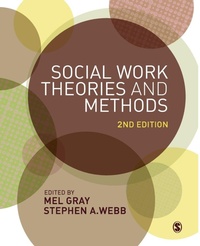
Social Work Theories and Methods
Description
The new edition includes a focus on the psychosocial perspective, with three new chapters on:
- Cognitive behavioural approaches
- Attachment theory and psychoanalytic social work
- Ecological approaches
Each chapter allows the reader to relate the theories and methods discussed to their own personal experiences. This reader friendly book includes student questions, glossaries and recommended reading so that students and practitioners can reappraise and expand the knowledge they have learned.
This book will be valuable for undergraduate and postgraduate students taking courses in social work theory and research methods, social work interventions and perspectives as well as post qualifying students and researchers in social work.
Reviews / Votes
Praise for the first edition:'An excellent book that provides a good deal of valuable material to stimulate debate and to alert readers of the need to engage more critically with the wider world in which social work is located.
Professor Keith Popple, Professor of Social Work, London South Bank University
This edition has retained the feeling of difference that came with the original and thus makes an alternative contribution to this genre of social work texts. It challenges its social worker readership to step outside familiar frameworks and discourse and to travel with the contributors through wider academic scenery and both recapture old connections and inform some new possibilities. It is a modern text, exploring a vast historical panorama, which successfully fuses theories of explanation with methods of intervention, enabling the reader to think about where today's theoretically informed social work practice has come from. -- Dr. Wulf Livingston
More details
Other editions
Additional editions
Previous edition
Persons
Stephen Webb is Professor of Human Sciences and Director of the Research Institute for Social Inclusion and Wellbeing at the University of Newcastle in New South Wales, Australia. His research focuses on theoretical approaches to social work drawing on contemporary social theory, evidence-based practice and social work ethics and values. He is author of several books including most recently Social Work in a Risk Society (Palgrave 2006) and Evidence-based Social Work (with Gray & Plath, Routledge 2009). He is co-editor (with Gray) of Sage′s four-volume International Social Work (2009), which includes a selection of seminal social work texts, and Ethics and Value Perspectives in Social Work (with Gray, Palgrave 2009). Most recently he has completed the Second Edition of Social Work Theories and Methods (with Gray, Sage) and New Politics of Critical Social Work (with Gray, Palgrave).
Content
PART ONE: THEORISTS
Jurgen Habermas - Stan Houston
Anthony Giddens - Harry Ferguson
Pierre Bourdieu - Paul Michael Garrett
Michel Foucault - Jason Powell
Judith Butler - Brid Featherstone and Lorraine Green
PART TWO: THEORIES
Attachment theory - David Howe
Feminist social work - Joan Orme
Critical social work - Mel Gray and Stephen A. Webb
Structural social work - Kate Murray and Steven Hick
Multiculturalism - Purnima Sundar and Mylan Ly
Neoliberalism - Sue Penna and Martin O'Brien
Postmodern social work - Barbara Fawcett
PART THREE: PERSPECTIVES FOR PRACTICE
Cognitive-behavioural approach - Eric L. Garland and A. Bruce Thyer
Ecological approach - Fred Besthorn
Social network analysis - Deirdre Kirke
Ethnography - Jerry Floersch, Jeffrey Longhofer and Megan Nordquest Schwaille
Ethnomethodology - Gerald de Montigny
Discourse and reflexivity - Sue White
Evidence-based practice - Debbie Plath
Ways of knowing - Ian Shaw