

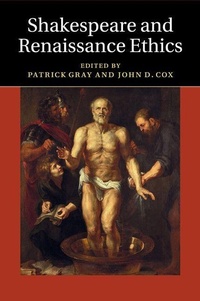
Shakespeare and Renaissance Ethics
Published on 26. October 2017
Book
Paperback/Softback
320 pages
978-1-107-41981-0 (ISBN)
Description
Written by a distinguished international team of contributors, this volume explores Shakespeare's vivid depictions of moral deliberation and individual choice in light of Renaissance debates about ethics. Examining the intellectual context of Shakespeare's plays, the essays illuminate Shakespeare's engagement with the most pressing moral questions of his time, considering the competing claims of politics, Christian ethics and classical moral philosophy, as well as new perspectives on controversial topics such as conscience, prayer, revenge and suicide. Looking at Shakespeare's responses to emerging schools of thought such as Calvinism and Epicureanism, and assessing comparisons between Shakespeare and his French contemporary Montaigne, the collection addresses questions such as: when does laughter become cruel? How does style reflect moral perspective? Does shame lead to self-awareness? This book is of great interest to scholars and students of Shakespeare studies, Renaissance studies and the history of ethics.
More details
Language
English
Place of publication
Cambridge
United Kingdom
Target group
Professional and scholarly
College/higher education
Product notice
Paperback (trade)
Dimensions
Height: 266 mm
Width: 149 mm
Thickness: 22 mm
Weight
489 gr
ISBN-13
978-1-107-41981-0 (9781107419810)
Copyright in bibliographic data and cover images is held by Nielsen Book Services Limited or by the publishers or by their respective licensors: all rights reserved.
Schweitzer Classification
Other editions
Additional editions
Patrick Gray | John D. Cox
Shakespeare and Renaissance Ethics
Book
07/2014
Cambridge University Press
€110.50
Shipment within 15-20 days
Persons
Patrick Gray is Lecturer in Shakespeare and Renaissance Literature in the Department of English Studies at the University of Durham. He has taught Shakespeare, classics, and comparative literature at Deep Springs College, Providence College, Rhode Island, and the United States Military Academy at West Point. His research interests include shame, guilt, the ethics of recognition (Anerkennung), and the reception of the classics in the Renaissance. John D. Cox is DuMez Professor of English at Hope College, Michigan. He is the author of many articles and books including The Devil and the Sacred in English Drama, 1350-1642 (Cambridge, 2000), the co-editor of A New History of Early English Drama (1997) and the third Arden 3 Henry VI (2001), and the editor of Julius Caesar: A Broadview Internet Shakespeare Edition (2012).
Content
Introduction: rethinking Shakespeare and ethics Patrick Gray and John D. Cox; Part I. Shakespeare and Classical Ethics: 1. Fame, eternity, and Shakespeare's Romans Gordon Braden; 2. Shakespeare and the ethics of laughter Indira Ghose; 3. Aristotelian shame and Christian mortification in Love's Labour's Lost Jane Kingsley-Smith; 4. Shakespeare's Vergil: empathy and The Tempest Leah Whittington; Part II. Shakespeare and Christian Ethics: 5. Shakespeare's prayers John D. Cox; 6. The morality of milk: Shakespeare and the ethics of nursing Beatrice Groves; 7. Hamlet the rough-hewer: moral agency and the consolations of Reformation thought Russell M. Hillier; 8. 'Wrying but a little'? Marriage, punishment, and forgiveness in Cymbeline Robert S. Miola; Part III. Shakespeare and the Ethical Thinking of Montaigne: 9. 'Hide thy selfe': Montaigne, Hamlet, and Epicurean ethics Patrick Gray; 10. Conscience and the god-surrogate in Montaigne and Measure for Measure William M. Hamlin; 11. Shakespeare, Montaigne, and classical reason Peter Holbrook; 12. Madness, proverbial wisdom, and philosophy in King Lear Peter Mack.