

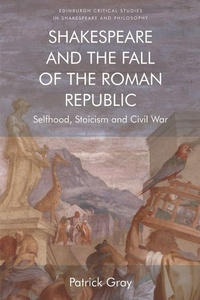
Shakespeare and the Fall of the Roman Republic
Selfhood, Stoicism and Civil War
Published on 7. November 2018
Book
Hardback
320 pages
978-1-4744-2745-6 (ISBN)
Description
Explores Shakespeare's representation of the failure of democracy in ancient Rome Shakespeare and the Fall of the Roman Republic introduces Shakespeare as a historian of ancient Rome alongside figures such as Sallust, Cicero, St Augustine, Machiavelli, Gibbon, Hegel and Nietzsche. In Julius Caesar and Antony and Cleopatra, Shakespeare shows Rome's transition from Republic to Empire. Why did Rome degenerate into an autocracy? Alternating between ruthless competition, Stoicism, Epicureanism and self-indulgent fantasies, Rome as Shakespeare sees it is inevitably bound for civil war. Shakespeare and the Fall of the Roman Republic considers Shakespeare's place in the history of concepts of selfhood and reflects on his sympathy for Christianity, in light of his reception of medieval Biblical drama, as well as his allusions to the New Testament. Shakespeare's critique of Romanitas anticipates concerns about secularisation, individualism and liberalism shared by philosophers such as Hannah Arendt, Alasdair MacIntyre, Charles Taylor, Michael Sandel and Patrick Deneen.
Key Features:
Explains Shakespeare's interpretation of the underlying causes of the Roman Republican civil warsShows how Shakespeare uses Roman history as a testing-ground to arbitrate between competing claims about human natureArticulates Shakespeare's distinctive, compromise position on selfhoodSituates Shakespeare within the intellectual history of individualism, Christianity, Romanticism, secularization, and political liberalism
Key Features:
Explains Shakespeare's interpretation of the underlying causes of the Roman Republican civil warsShows how Shakespeare uses Roman history as a testing-ground to arbitrate between competing claims about human natureArticulates Shakespeare's distinctive, compromise position on selfhoodSituates Shakespeare within the intellectual history of individualism, Christianity, Romanticism, secularization, and political liberalism
Reviews / Votes
Gray's penetrating eye for textual analysis, his vast and versatile erudition and his extreme sensitivity for the depths of the complexity of the human mind result in gripping new insights into two plays that, it turns out, we did not know as well as we thought. -- Domenico Lovascio, Universita degli Studi di Genova * Early Modern Literary Studies * Patrick Gray's new book pulls together a wealth of up-to-date Shakespeare criticism, classical literature, theology, philosophy and theory into a fluent argument which bears on the deepest possibilities of self and society. The lucid case it makes is still relevant today: Shakespeare's Roman plays point over the horizon towards a more sympathetic and communal culture. * Ewan Fernie, The Shakespeare Institute, University of Birmingham Stratford-upon-Avon * mark[s] the emergence of a new and excitingly different voice in Shakespeare studies. -- Andrew Hadfield, University of Sussex * Renaissance Quarterly Vol. LXXI I I , No. 1 *More details
Series
Language
English
Place of publication
Edinburgh
United Kingdom
Target group
Professional and scholarly
Product notice
sewn/stitched
Cloth over boards
Dimensions
Height: 234 mm
Width: 160 mm
Thickness: 23 mm
Weight
590 gr
ISBN-13
978-1-4744-2745-6 (9781474427456)
Copyright in bibliographic data and cover images is held by Nielsen Book Services Limited or by the publishers or by their respective licensors: all rights reserved.
Schweitzer Classification
Other editions
Additional editions
E-Book
09/2018
1st Edition
Edinburgh University Press
€81.99
Available for download
Person
Patrick Gray is Associate Professor of English Studies and Director of Liberal Arts at Durham University. He is the author of Shakespeare and the Fall of the Roman Republic: Selfhood, Stoicism, and Civil War (2019), editor of Shakespeare and the Ethics of War (2019), and co-editor of Shakespeare and Renaissance Ethics (2014). His essays have appeared in Shakespeare Survey, Shakespeare Jahrbuch, Skene, JMEMS, Comparative Drama, and Textual Practice.
Content
Dedication
Acknowledgments
Introduction: Shakespeare and the vulnerable self
Part I. Julius Caesar
Chapter 1. "A beast without a heart": Pietas and pity in Julius Caesar
Chapter 2. "The northern star": Constancy and passibility in Julius Caesar
Conclusion to Part 1: Shakespeare's Passion play
Part II. Antony and Cleopatra
Chapter 3. "The high Roman fashion": Suicide and Stoicism in Antony and Cleopatra
Chapter 4. "A spacious mirror": Interpellation and the other in Antony and Cleopatra
Conclusion to Part II: The last interpellation
Conclusion: Between humanism and antihumanism
Index
Acknowledgments
Introduction: Shakespeare and the vulnerable self
Part I. Julius Caesar
Chapter 1. "A beast without a heart": Pietas and pity in Julius Caesar
Chapter 2. "The northern star": Constancy and passibility in Julius Caesar
Conclusion to Part 1: Shakespeare's Passion play
Part II. Antony and Cleopatra
Chapter 3. "The high Roman fashion": Suicide and Stoicism in Antony and Cleopatra
Chapter 4. "A spacious mirror": Interpellation and the other in Antony and Cleopatra
Conclusion to Part II: The last interpellation
Conclusion: Between humanism and antihumanism
Index