

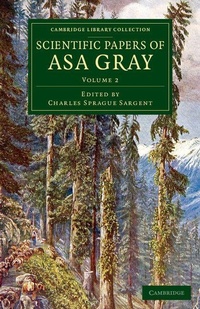
Scientific Papers of Asa Gray
Published on 2. July 2015
Book
Paperback/Softback
512 pages
978-1-108-08367-6 (ISBN)
Description
Born in the state of New York, Asa Gray (1810-88) abandoned a medical career to pursue his true interest in botany. He sought the mentorship of the influential American botanist John Torrey, and their collaborative efforts in classifying North American flora according to biological similarities paved the way for Gray's professorship at Harvard University after years of research. Gray was also one of the few scientists to whom Charles Darwin revealed his early ideas of evolutionary theory. After Gray's death, his fellow botanist Charles Sprague Sargent (1841-1927) compiled the lesser-known writings of a prolific author whose user-friendly Manual of the Botany of the Northern United States and other works inspired generations of botany enthusiasts. The two-volume collection appeared in 1889. Covering the period from 1841 to 1886, Volume 2 contains essays on botanical topics and biographical sketches of influential naturalists.
More details
Series
Language
English
Place of publication
Cambridge
United Kingdom
Target group
Professional and scholarly
Product notice
Paperback (trade)
Dimensions
Height: 216 mm
Width: 140 mm
Thickness: 30 mm
Weight
715 gr
ISBN-13
978-1-108-08367-6 (9781108083676)
Copyright in bibliographic data and cover images is held by Nielsen Book Services Limited or by the publishers or by their respective licensors: all rights reserved.
Schweitzer Classification
Other editions
Complete work / Part of the work
Asa Gray | Charles Sprague Sargent
Scientific Papers of Asa Gray 2 Volume Set
Book
07/2015
Cambridge University Press
€100.59
Article is exhausted, reprint undefined
Persons
Asa Gray, who lived from November 18, 1810, to January 30, 1888, is regarded as the most significant American botanist of the 1800s. His Darwiniana was seen as a seminal account of how science and faith did not always have to conflict. Gray insisted that all members of a species have to be genetically related. Additionally, he was adamantly against the concepts of special creation, which prevents evolution, and hybridization within a single generation. Despite the fact that Gray's theistic evolution was directed by a Creator, he was a fervent Darwinist. Throughout his many years as a botany professor at Harvard University, Gray maintained regular correspondence and visits with many of the top natural scientists of the day, including Charles Darwin, who thought highly of him. In addition to visits to the southern and western regions of the United States, Gray made multiple travels to Europe in order to work with prominent European scientists of the day. He also established a wide network of collectors of specimens. Being a prolific writer, he played a significant role in bringing North American plant taxonomy together.
Content
Essays; Biographical sketches; Index.