

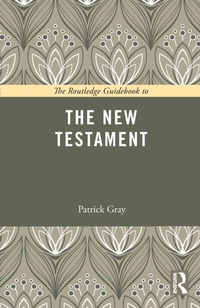
The Routledge Guidebook to The New Testament
1st Edition
Published on 20. March 2017
Book
Paperback/Softback
300 pages
978-0-415-72904-8 (ISBN)
Description
As part of the Christian canon of scripture, the New Testament is one of the most influential works in history. Its impact can be seen in many different fields, but without an awareness of the historical, cultural, social, and intellectual context of early Christianity, it can be difficult for modern-day readers to fully understand what the first-century authors were trying to say and how the first readers of the New Testament would have understood these ideas.
The Routledge Guidebook to the New Testament offers an academic introduction to the New Testament examining:
The social and historical context in which the New Testament was written
The primary text, supporting students in close analysis from a range of consensus positions
The contemporary reception and ongoing influence of the New Testament
With further reading suggestions, this guidebook is essential reading for all students of religion and philosophy, and all those wishing to engage with this important work.
The Routledge Guidebook to the New Testament offers an academic introduction to the New Testament examining:
The social and historical context in which the New Testament was written
The primary text, supporting students in close analysis from a range of consensus positions
The contemporary reception and ongoing influence of the New Testament
With further reading suggestions, this guidebook is essential reading for all students of religion and philosophy, and all those wishing to engage with this important work.
Reviews / Votes
This exceptionally helpful and highly readable Guidebook is ideal for anyone looking for an introduction to the New Testament and its world. This book will enable a reader to appreciate the New Testament and its subsequent influence with greater depth and insight. Informed by the latest scholarship, it presents the range of scholarly views on key matters of debate, and the definition of key terms and answers to 'frequently asked questions' add greatly to its value. Paul Trebilco, University of Otago, New ZealandMore details
Series
Language
English
Place of publication
London
United Kingdom
Publishing group
Taylor & Francis Ltd
Target group
College/higher education
Dimensions
Height: 198 mm
Width: 129 mm
Thickness: 17 mm
Weight
336 gr
ISBN-13
978-0-415-72904-8 (9780415729048)
Copyright in bibliographic data and cover images is held by Nielsen Book Services Limited or by the publishers or by their respective licensors: all rights reserved.
Schweitzer Classification
Other editions
Additional editions
Patrick Gray
The Routledge Guidebook to The New Testament
Book
03/2017
1st Edition
Routledge
€178.27
Shipment within 15-20 days
Patrick Gray
The Routledge Guidebook to The New Testament
E-Book
02/2017
Routledge
€35.49
Available for download
Patrick Gray
The Routledge Guidebook to The New Testament
E-Book
02/2017
Routledge
€35.49
Available for download
Person
Patrick Gray is Associate Professor of Religious Studies at Rhodes College.
Content
Abbreviations
Introduction
I. The Context of Early Christianity and the New Testament
II. The Literature of the New Testament: The Gospels and the Acts of the Apostles
Mark
Matthew
Luke-Acts
John
III. The Literature of the New Testament: Letters
The Letters of Paul
Romans
1 Corinthians
2 Corinthians
Galatians
Ephesians
Philippians
Colossians
1-2 Thessalonians
The Pastoral Epistles (1-2 Timothy, Titus)
Philemon
The Letter to the Hebrews
The General Epistles
James
1-2 Peter
1, 2, 3 John
Jude
IV. The Literature of the New Testament: Apocalyptic Literature
Revelation
V. Key Concepts
VI. General Issues
What do we know about the life of Jesus?
What language did Jesus speak?
How do we know what Jesus really said?
How should the miracles in the New Testament be understood?
Did Jesus found a new religion?
Is the New Testament anti-Semitic?
Who wrote the New Testament?
How do we know when the books of the New Testament were written?
Why does the New Testament contain (only) twenty-seven books?
How should one read the non-canonical writings?
How are the Dead Sea Scrolls related to the New Testament?
Should the New Testament be read "literally"?
What special methods do scholars use to interpret the New Testament?
VII. For Further Study
Bibliography
Index
Introduction
I. The Context of Early Christianity and the New Testament
II. The Literature of the New Testament: The Gospels and the Acts of the Apostles
Mark
Matthew
Luke-Acts
John
III. The Literature of the New Testament: Letters
The Letters of Paul
Romans
1 Corinthians
2 Corinthians
Galatians
Ephesians
Philippians
Colossians
1-2 Thessalonians
The Pastoral Epistles (1-2 Timothy, Titus)
Philemon
The Letter to the Hebrews
The General Epistles
James
1-2 Peter
1, 2, 3 John
Jude
IV. The Literature of the New Testament: Apocalyptic Literature
Revelation
V. Key Concepts
VI. General Issues
What do we know about the life of Jesus?
What language did Jesus speak?
How do we know what Jesus really said?
How should the miracles in the New Testament be understood?
Did Jesus found a new religion?
Is the New Testament anti-Semitic?
Who wrote the New Testament?
How do we know when the books of the New Testament were written?
Why does the New Testament contain (only) twenty-seven books?
How should one read the non-canonical writings?
How are the Dead Sea Scrolls related to the New Testament?
Should the New Testament be read "literally"?
What special methods do scholars use to interpret the New Testament?
VII. For Further Study
Bibliography
Index