

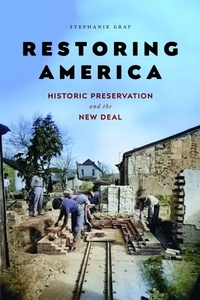
Restoring America
Historic Preservation and the New Deal
Published on 12. December 2025
Book
Hardback
304 pages
978-1-62534-898-2 (ISBN)
Description
Exploring how the New Deal shaped history through politically driven commemoration
During the Great Depression, Americans employed historic preservation as a tool to address the political, economic, and social upheavals of the era. Inspired by the Roosevelt administration's unprecedented support of federal arts projects, US politicians, architects, laborers, artisans, and local boosters skillfully used New Deal funds to restore, mythologize, and politicize the 'historic shrines' in their communities. Restoring America illustrates how and why Americans turned to historic preservation as a strategy for managing both political realities and ambitions.
Stephanie Gray presents four thoroughly researched and diverse case studies: a colonial theater in the Deep South, a Puritan minister's home in New England, aviator Charles Lindbergh's modest farmhouse and parklands of the Upper Midwest, and a multi-layered Spanish-German-Mexican arts village in the Central South. Collectively, these examples show how the restoration of old places emerged as a popular form of cultural production, an instrument of economic reconstruction, and a striking expression of political theater during the Depression. Moreover, these New Deal preservation projects make evident that any exercise in physically preserving the past is both conservative and progressive, reactive and proactive.
Restoring America contends that the federally funded and locally driven preservation initiatives of the 1930s and 1940s can help inform contemporary public history debates over the politics of commemoration and imagine possibilities for future preservation practice.
During the Great Depression, Americans employed historic preservation as a tool to address the political, economic, and social upheavals of the era. Inspired by the Roosevelt administration's unprecedented support of federal arts projects, US politicians, architects, laborers, artisans, and local boosters skillfully used New Deal funds to restore, mythologize, and politicize the 'historic shrines' in their communities. Restoring America illustrates how and why Americans turned to historic preservation as a strategy for managing both political realities and ambitions.
Stephanie Gray presents four thoroughly researched and diverse case studies: a colonial theater in the Deep South, a Puritan minister's home in New England, aviator Charles Lindbergh's modest farmhouse and parklands of the Upper Midwest, and a multi-layered Spanish-German-Mexican arts village in the Central South. Collectively, these examples show how the restoration of old places emerged as a popular form of cultural production, an instrument of economic reconstruction, and a striking expression of political theater during the Depression. Moreover, these New Deal preservation projects make evident that any exercise in physically preserving the past is both conservative and progressive, reactive and proactive.
Restoring America contends that the federally funded and locally driven preservation initiatives of the 1930s and 1940s can help inform contemporary public history debates over the politics of commemoration and imagine possibilities for future preservation practice.
Reviews / Votes
"Restoring America is fascinating and original, with deep research into government papers, architectural plans, New Deal publications, local newspapers, memoirs, oral histories, the records of local organizations, and tourist ads. It makes an important contribution to scholarship that explores how the New Deal shaped conceptions of the American past." - Sharon Ann Musher, author of Democratic Art: The New Deal's Influence on American Culture"Gray has done an impressive job of turning deep archival research into clear narratives of the four selected projects. It is no small task to piece together these four separate histories, all with distinct actors, sites, local interests, and circumstances. Her command of the details and complexities of each project make the book a pleasure to read and accessible to both students and scholars." - Whitney Martinko, author of Historic Real Estate: Market Morality and the Politics of Preservation in the Early United States
More details
Series
Language
English
Place of publication
Massachusetts
United States
Target group
Professional and scholarly
Product notice
sewn/stitched
Cloth over boards
Illustrations
24 illus.
Dimensions
Height: 236 mm
Width: 155 mm
Thickness: 24 mm
Weight
576 gr
ISBN-13
978-1-62534-898-2 (9781625348982)
Copyright in bibliographic data and cover images is held by Nielsen Book Services Limited or by the publishers or by their respective licensors: all rights reserved.
Schweitzer Classification
Person
Stephanie Gray is assistant professor of public history at Duquesne University. She has published on historic preservation in journals such as The Public Historian and Journal of African American History, in blogs like The Metropole, and in government documents.
Content
List of Illustrations
Acknowledgments
Introduction
1. America's Preservation Impulse Before and During the New Deal
2. The "Compelling Romance" of the Old South: The Dock Street Theatre, Charleston, South Carolina
3. The Puritan Past at the Old Stone House: The Henry Whitfield State Museum, Guilford, Connecticut
4. Cultivating the Minnesota Frontier: The Charles A. Lindbergh Boyhood Home and State Park, Little Falls, Minnesota
5. Maverick's Pan-American Vision: La Villita Historic Arts Village, San Antonio, Texas
Conclusion
Appendix A. "Historic Shrines" Restored by the Works Progress Administration
Appendix B. National Park Service Restoration Policies, May 19, 1937
Notes
Index
Acknowledgments
Introduction
1. America's Preservation Impulse Before and During the New Deal
2. The "Compelling Romance" of the Old South: The Dock Street Theatre, Charleston, South Carolina
3. The Puritan Past at the Old Stone House: The Henry Whitfield State Museum, Guilford, Connecticut
4. Cultivating the Minnesota Frontier: The Charles A. Lindbergh Boyhood Home and State Park, Little Falls, Minnesota
5. Maverick's Pan-American Vision: La Villita Historic Arts Village, San Antonio, Texas
Conclusion
Appendix A. "Historic Shrines" Restored by the Works Progress Administration
Appendix B. National Park Service Restoration Policies, May 19, 1937
Notes
Index