

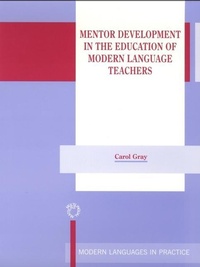
Mentor Development in the Education of Modern Language Teachers
Published on 17. October 2001
Book
Paperback/Softback
240 pages
978-1-85359-551-6 (ISBN)
Description
This book investigates a number of case studies of language mentoring in action with a view to prompting readers to reflect upon their own practice as teacher educators. Recent research on mentoring, teacher effectiveness, language teaching and language teacher education is combined to provide a background to the case studies, helping to illuminate general principles and issues.
More details
Series
Language
English
Place of publication
Bristol
United Kingdom
Publishing group
Channel View Publications Ltd
Target group
Professional and scholarly
Product notice
Paperback (trade)
Dimensions
Height: 225 mm
Width: 170 mm
Thickness: 13 mm
Weight
385 gr
ISBN-13
978-1-85359-551-6 (9781853595516)
Copyright in bibliographic data and cover images is held by Nielsen Book Services Limited or by the publishers or by their respective licensors: all rights reserved.
Schweitzer Classification
Other editions
Additional editions
Book
10/2001
Multilingual Matters
€133.63
Article exhausted; check different version
E-Book
10/2001
1st Edition
Multilingual Matters
€14.49
Available for download
Person
Carol Gray joined the University of Birmingham in 1993 after 12 years of teaching languages in comprehensive, independent and special schools. Her development from classroom practitioner to lecturer in education thus parallels the growth of partnership and of mentoring. Alongside her PGCE work she teaches on Masters level modules in MFL Curriculum Development and in Mentoring.
Content
Glossary of Abbreviations
Introduction: Or Why Another Book on Mentoring?
Part 1: The Context
1.1 A Local and National Context with International Implications
1.2 What Makes a Good Language Teacher?
1.3 Learning to be a Language Teacher
1.4 The Intuitively Theoretical Mentor
Part 2: Developing Pedagogical Content Knowledge in Mentoring
Introduction to Part 2
2.1 Keeping Pace with Development Through the Weekly Meetings
2.2 Providing Feedback
2.3 Towards Departmental Consistency of Good Practice in Observing Student Teacher Lessons
2.4 Focusing on the Learner
2.5 Good Teachers Can Wear Turquoise Socks or When Good Mentoring is Simply Not Enough
Part 3: Mentors in Action
Introduction to Part 3
3.1 Reassuring the Student Teacher That Everyone Experiences Difficulties
3.2 Being There
3.3 Reflective Practice and Collaboration
3.4 Probing Theories in Practice
3.5 A Tutor in Action
Part 4: Towards a Better Future?
4.1 Towards a Better Future?
Bibliography
Index
Introduction: Or Why Another Book on Mentoring?
Part 1: The Context
1.1 A Local and National Context with International Implications
1.2 What Makes a Good Language Teacher?
1.3 Learning to be a Language Teacher
1.4 The Intuitively Theoretical Mentor
Part 2: Developing Pedagogical Content Knowledge in Mentoring
Introduction to Part 2
2.1 Keeping Pace with Development Through the Weekly Meetings
2.2 Providing Feedback
2.3 Towards Departmental Consistency of Good Practice in Observing Student Teacher Lessons
2.4 Focusing on the Learner
2.5 Good Teachers Can Wear Turquoise Socks or When Good Mentoring is Simply Not Enough
Part 3: Mentors in Action
Introduction to Part 3
3.1 Reassuring the Student Teacher That Everyone Experiences Difficulties
3.2 Being There
3.3 Reflective Practice and Collaboration
3.4 Probing Theories in Practice
3.5 A Tutor in Action
Part 4: Towards a Better Future?
4.1 Towards a Better Future?
Bibliography
Index