

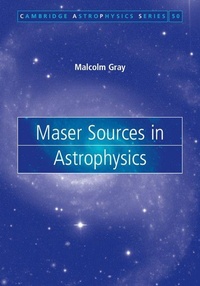
Maser Sources in Astrophysics
Published on 26. April 2012
Book
Hardback
430 pages
978-0-521-87980-4 (ISBN)
Description
Masers are observed at a range of scales - from comets, through star-forming clouds, to galactic nuclei - and have many astrophysical applications, for example measuring cosmological distances. Written for postgraduate students and professional researchers in molecular astrophysics, this volume is an up-to-date survey of the theory and observations of astrophysical maser sources and their use as astronomical tools. The book summarizes the history of the discovery of various maser molecules and lines, and discusses maser observations on various scales. The theory is discussed in detail, including the quantum-mechanical response of the molecules, before being linked to more general radiation transfer. A discussion of spectral-line radio astronomy techniques shows how maser observations can be applied more generally to radio astronomy. The book introduces new and projected instruments, including ALMA and SKA. Additional topics address the radiation statistics of astrophysical masers, and numerical methods of analysis.
More details
Series
Language
English
Place of publication
Cambridge
United Kingdom
Target group
Professional and scholarly
Illustrations
10 Tables, black and white; 58 Line drawings, black and white
Dimensions
Height: 250 mm
Width: 175 mm
Thickness: 28 mm
Weight
917 gr
ISBN-13
978-0-521-87980-4 (9780521879804)
Copyright in bibliographic data and cover images is held by Nielsen Book Services Limited or by the publishers or by their respective licensors: all rights reserved.
Schweitzer Classification
Other editions
Additional editions
Malcolm Gray
Maser Sources in Astrophysics
E-Book
06/2012
1st Edition
Cambridge University Press
€112.99
Available for download
Person
Malcolm Gray is a Senior Lecturer at the Jodrell Bank Centre for Astrophysics at the University of Manchester. Astrophysical masers have been a major theme in Dr Gray's research career, but he has also worked in the fields of astrophysical dust, the calculation of collision cross-sections for astrophysical molecules and radiation transfer.
Content
1. Introduction; 2. Discovery; 3. Basic theory; 4. Observations of masers; 5. Maser molecules; 6. Environments of masers; 7. Advanced theory; 8. Computer modelling; 9. Masers as diagnostics; 10. Future prospects; Appendices; Index.