

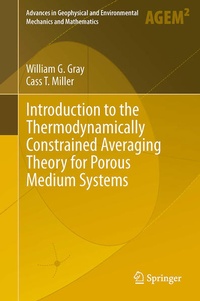
Introduction to the Thermodynamically Constrained Averaging Theory for Porous Medium Systems
Published on 10. March 2014
Book
Hardback
XXXIV, 582 pages
978-3-319-04009-7 (ISBN)
Description
Thermodynamically constrained averaging theory provides a consistent method for upscaling conservation and thermodynamic equations for application in the study of porous medium systems. The method provides dynamic equations for phases, interfaces, and common curves that are closely based on insights from the entropy inequality. All larger scale variables in the equations are explicitly defined in terms of their microscale precursors, facilitating the determination of important parameters and macroscale state equations based on microscale experimental and computational analysis. The method requires that all assumptions that lead to a particular equation form be explicitly indicated, a restriction which is useful in ascertaining the range of applicability of a model as well as potential sources of error and opportunities to improve the analysis.
More details
Series
Edition
2014 ed.
Language
English
Place of publication
Cham
Switzerland
Publishing group
Springer International Publishing
Target group
Professional and scholarly
Research
Illustrations
1 s/w Abbildung, 11 farbige Abbildungen
XXXIV, 582 p. 12 illus., 11 illus. in color.
Dimensions
Height: 241 mm
Width: 160 mm
Thickness: 39 mm
Weight
1080 gr
ISBN-13
978-3-319-04009-7 (9783319040097)
DOI
10.1007/978-3-319-04010-3
Schweitzer Classification
Other editions
Additional editions

William G. Gray | Cass T. Miller
Introduction to the Thermodynamically Constrained Averaging Theory for Porous Medium Systems
Book
10/2016
Springer
€117.69
Shipment within 10-15 days
William G. Gray | Cass T. Miller
Introduction to the Thermodynamically Constrained Averaging Theory for Porous Medium Systems
E-Book
02/2014
1st Edition
Springer
€106.99
Available for download
Content
Chapter 1 Elements of Thermodynamically Constrained Averaging Theory.- Chapter 2 Microscale Conservation Principles.- Chapter 3 Microscale Thermodynamics.- Chapter 4 Microscale Equilibrium Conditions.- Chapter 5 Microscale Closure for a Fluid Phase.- Chapter 6 Macroscale Conservation Principles.- Chapter 7 Macroscale Thermodynamics.- Chapter 8 Evolution Equations.- Chapter 9 Single-Fluid-Phase Flow.- Chapter 10 Single-Fluid-Phase Species Transport.- Chapter 11 Two-Phase Flow.- Chapter 12 Modeling Approach and Extensions.- Appendix A Considerations on Calculus of Variations.- Appendix B Derivations of Averaging Theorems.- Appendix C Constrained Entropy Inequality Derivations.- Index.