

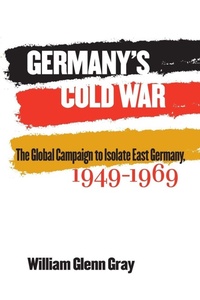
Germany's Cold War
The Global Campaign to Isolate East Germany, 1949-1969
Published on 1. March 2014
Book
Paperback/Softback
368 pages
978-1-4696-1471-7 (ISBN)
Description
Using newly available material from both sides of the Iron Curtain, William Glenn Gray explores West Germany's efforts to prevent international acceptance of East Germany as a legitimate state following World War II.
Unwilling to accept the division of their country, West German leaders regarded the German Democratic Republic (GDR) as an illegitimate upstart--a puppet of the occupying Soviet forces. Together with France, Britain, and the United States, West Germany applied political and financial pressure around the globe to ensure that the GDR remain unrecognized by all countries outside the communist camp. Proclamations of ideological solidarity and narrowly targeted bursts of aid gave the GDR momentary leverage in such diverse countries as Egypt, Iraq, Ghana, and Indonesia; yet West Germany's intimidation tactics, coupled with its vastly superior economic resources, blocked any decisive East German breakthrough.
Gray argues that Bonn's isolation campaign was dropped not for want of success, but as a result of changes in West German priorities as the struggle against East Germany came to hamper efforts at reconciliation with Israel, Poland, and Yugoslavia--all countries of special relevance to Germany's recent past. Interest in a morally grounded diplomacy, together with the growing conviction that the GDR could no longer be ignored, led to the abandonment of Bonn's effective but outdated efforts to hinder worldwide recognition of the East German regime.
Unwilling to accept the division of their country, West German leaders regarded the German Democratic Republic (GDR) as an illegitimate upstart--a puppet of the occupying Soviet forces. Together with France, Britain, and the United States, West Germany applied political and financial pressure around the globe to ensure that the GDR remain unrecognized by all countries outside the communist camp. Proclamations of ideological solidarity and narrowly targeted bursts of aid gave the GDR momentary leverage in such diverse countries as Egypt, Iraq, Ghana, and Indonesia; yet West Germany's intimidation tactics, coupled with its vastly superior economic resources, blocked any decisive East German breakthrough.
Gray argues that Bonn's isolation campaign was dropped not for want of success, but as a result of changes in West German priorities as the struggle against East Germany came to hamper efforts at reconciliation with Israel, Poland, and Yugoslavia--all countries of special relevance to Germany's recent past. Interest in a morally grounded diplomacy, together with the growing conviction that the GDR could no longer be ignored, led to the abandonment of Bonn's effective but outdated efforts to hinder worldwide recognition of the East German regime.
More details
Series
Edition
New edition
Language
English
Place of publication
Chapel Hill
United States
Target group
College/higher education
Professional and scholarly
Edition type
New edition
Dimensions
Height: 234 mm
Width: 156 mm
Thickness: 22 mm
Weight
629 gr
ISBN-13
978-1-4696-1471-7 (9781469614717)
Copyright in bibliographic data and cover images is held by Nielsen Book Services Limited or by the publishers or by their respective licensors: all rights reserved.
Schweitzer Classification
Other editions
Additional editions
E-Book
11/2003
The University of North Carolina Press
€29.49
Available for download
Person
William Glenn Gray is assistant professor of history at Purdue University.