

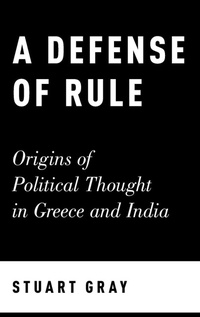
A Defense of Rule
Origins of Political Thought in Greece and India
Published on 27. April 2017
Book
Hardback
304 pages
978-0-19-063631-9 (ISBN)
Description
At its core, politics is all about relations of rule. Accordingly one of the central preoccupations of political theory is what it means for human beings to rule over one another or share in a process of ruling. While political theorists tend to regard rule as a necessary evil, this book aims to explain how rule need not be understood as anathema to political life. Rather, by looking at some of the earliest traditions of political thought we can rethink rule in ways that evoke stewardship rather than domination.
Stuart Gray argues that hierarchical ideas about rule coevolved with political divisions between the human and non-human in western theory. The earliest discernible Greek thought advanced an instrumental relationship between humans and their environment, a position that has persisted into our current age. While this seems a defensible position, Gray points out that such instrumental understandings of the nonhuman world have gotten us into serious trouble, including problems of deforestation, global warming, rising sea levels, species loss, and peak oil.
To rethink the concept of rule, A Defense of Rule turns to early Indian political thought that suggests that rule is a relationship predicated on stewardship. The book compares these two traditions of thought in order to suggest that we have a normative duty to the environment, and thus to act in a way that takes the interests of non-human nature into account. Basing his argument on his own original translations of primary sources in ancient Greek and Sanskrit, Gray shows when and how early concepts of rule evolved to justify divisions between the human and nonhuman. In doing so, he argues for a reconsideration of our duties toward the nonhuman natural world.
Stuart Gray argues that hierarchical ideas about rule coevolved with political divisions between the human and non-human in western theory. The earliest discernible Greek thought advanced an instrumental relationship between humans and their environment, a position that has persisted into our current age. While this seems a defensible position, Gray points out that such instrumental understandings of the nonhuman world have gotten us into serious trouble, including problems of deforestation, global warming, rising sea levels, species loss, and peak oil.
To rethink the concept of rule, A Defense of Rule turns to early Indian political thought that suggests that rule is a relationship predicated on stewardship. The book compares these two traditions of thought in order to suggest that we have a normative duty to the environment, and thus to act in a way that takes the interests of non-human nature into account. Basing his argument on his own original translations of primary sources in ancient Greek and Sanskrit, Gray shows when and how early concepts of rule evolved to justify divisions between the human and nonhuman. In doing so, he argues for a reconsideration of our duties toward the nonhuman natural world.
Reviews / Votes
"Combining wide-ranging expertise in the history of political thought with exegetical brilliance and analytical sharpness, Stuart Gray reminds us that we can expand our political imagination by turning to two influential traditions of political thought-the ancient Greek and Vedic Indian-in order to re-envision the meaning of ruling. Gray not only takes us on a detailed, highly informed intellectual tour of both traditions, but also engages in the most importantwork of doing comparative political theory: using the encounter between the two to displace, trouble and otherwise renegotiate our most settled assumptions and conceptions about the meaning of rule."
--Farah Godrej, University of California, Riverside, author of Cosmopolitan Political Thought: Method, Practice, Discipline
"Stuart Gray's A Defense of Rule manages the difficult trick of making valuable contributions to two different discourses in political theory. On one level, it is an excellent piece of comparative political theory, but on another level, it is also an excellent contribution to the wide-ranging discourse about ethics and human/non-human relations. By looking back in this insightful, comparative manner, Gray elucidates a sustainable and just way to move
forward."
--Matthew Moore, author of Buddhism and Political Theory
"A thoughtful and innovative investigation of a frequently sidelined category: rule or ruling. The book breaks new ground by offering a nuanced comparison of ancient Greek and Indian thought. Given the dense interconnections of our world, the author envisages a cosmic extension of stewardship toward "panocracy" and "world-building" - possibly as antidotes to the looming ecological disaster."
--Fred Dallmayr, University of Notre Dame and author of Being in the World: Dialogue and Cosmopolis
"[Gray's] book does help us to "identify gaps in one tradition
by using a comparative vantage point" (174). It both underscores the
need, identified by numerous environmental political theorists today, to
take into account the interests of future generations, and suggests a metaphysical
case for taking into account the interests of nonhuman forms of life."
--Antony Black, University of Dundee
More details
Language
English
Place of publication
New York
United States
Target group
College/higher education
Dimensions
Height: 240 mm
Width: 161 mm
Thickness: 21 mm
Weight
622 gr
ISBN-13
978-0-19-063631-9 (9780190636319)
Copyright in bibliographic data and cover images is held by Nielsen Book Services Limited or by the publishers or by their respective licensors: all rights reserved.
Schweitzer Classification
Other editions
Additional editions
E-Book
03/2017
1st Edition
OUP eBook
€50.49
Available for download
E-Book
03/2017
1st Edition
OUP eBook
€39.49
Available for download
Person
Stuart Gray is Assistant Professor of Politics at Washington and Lee University.
Content
Preface
Acknowledgments
Introduction: Historical-Comparative Political Theory
Chapter 1: Homer: Ruling as Distinction
Chapter 2: Hesiod: Critique, Poetic Justice, and the Increasing Anthropocentrism of Greek Rule
Chapter 3: Vedic Political Thought: Hierarchy, Connectedness, and Cosmology
Chapter 4: Vedic Samhitas and Brahmanas: Ruling as Stewardship
Chapter 5: Comparative Considerations on the Meaning of Rule
Conclusion: Panocracy as a New Vision of Rule
Notes
References
Index
Acknowledgments
Introduction: Historical-Comparative Political Theory
Chapter 1: Homer: Ruling as Distinction
Chapter 2: Hesiod: Critique, Poetic Justice, and the Increasing Anthropocentrism of Greek Rule
Chapter 3: Vedic Political Thought: Hierarchy, Connectedness, and Cosmology
Chapter 4: Vedic Samhitas and Brahmanas: Ruling as Stewardship
Chapter 5: Comparative Considerations on the Meaning of Rule
Conclusion: Panocracy as a New Vision of Rule
Notes
References
Index