

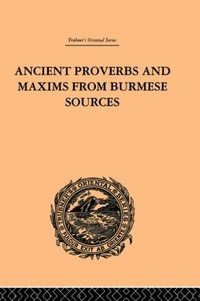
Ancient Proverbs and Maxims from Burmese Sources
Or The Niti Literature of Burma
1st Edition
Published on 23. November 2000
Book
Hardback
194 pages
978-0-415-24549-4 (ISBN)
Description
First published in 2000. This is Volume II of seven of a series on Southeast Asia. Written in 1886, this is a collection of ancient proverbs and maxims from Burmese sources or the Niti literature of Burma. The Sanskrit-Pali word Niti is equivalent to conduct in its abstract, and guide in its concrete signification.
Reviews / Votes
"With very limited material on Myanmar culture and literature translated into English, this book covers collections of codes of conduct, principles of morality, maxims and ethical recommendations for different kind of people (general reader, powerful elites, etc) in ancient times in Myanmar. Reading these beautiful texts will expand your knowledge on Myanmar Buddhist culture and tradition...This book will be a valuable gem for those interested in learning about Burmese culture and literature in ancient times."Patricia Ordonez de Pablos, The University of Oviedo, International Journal of Asian Business and Information Management
More details
Language
English
Place of publication
London
United Kingdom
Publishing group
Taylor & Francis Ltd
Target group
College/higher education
Dimensions
Height: 216 mm
Width: 138 mm
Weight
385 gr
ISBN-13
978-0-415-24549-4 (9780415245494)
Copyright in bibliographic data and cover images is held by Nielsen Book Services Limited or by the publishers or by their respective licensors: all rights reserved.
Schweitzer Classification
Other editions
Additional editions
Book
12/2014
1st Edition
Routledge
€70.70
Shipment within 10-20 days
E-Book
07/2013
1st Edition
Routledge
€64.49
Available for download
E-Book
07/2013
1st Edition
Routledge
€64.49
Available for download
Person
James Gray
Content
Chapter 1 The Lokaniti. 1 I have selected this Niti for translation before the others because it is the most popular in Burma. Its popularity during recent years has been increased by printed editions of it emanating from the presses of Rangoon. It forms, besides, a textbook for the vernacular schools of the province. The Pali text of it is very corrupt in many places, and an emended edition has not yet been attempted. The Lokaniti ("Worldly Behaviour") is divided into seven sections, viz., (1) T HE E VIL -D OER, (2) T HE G OOD M AN, (3) T HE E VIL -D OER, (4) F RIENDSHIP, (5) W OMAN, (6) K INGS, and (7) M ISCELLANEOUS. It was, for the first time, rendered into Burmese in A.D. 1835, during the reign of Bhagidaw, by the guru Cakkandabhisiri; Chapter 2 The Dhammaniti. 1 The Dhammaniti consists of 414 stanzas in 24 sections. It was for the first time translated into Burmese by the head priest Tipitakali?kara Mahadhamma in 1784 A.D., in obedience to the order of King Bodopra. The following three stanzas are introductory:- "Vanditva ratana? se??ha? Nissaya pubbake garu? Nitidhamma? pavakkhami Sabbalokasukhavaha?. Acariyo ca sippanca Panna sutar? katha dhana? Deso ca nissayo mitta? Dujjano sujano bala?. Itthi putto ca daso ca Gharavaso katakato Natabbo ca ala?karo Rajadhammopasevako Dukadimissako ceva Paki??ako ti matika." Translation:- Having paid homage to the Three Gems and to my venerable preceptor, I shall recite the Dhantmaniti, based on ancient works, for the benefit of the whole world. The Preceptor, Scholarship, Wisdom, Knowledge, Conversation, Wealth, Habitation, Dependence, Friendship, the Bad Man, the Good Man, the Powerful; Women, Children, Servants, Residence, What should be done, What should not be done, What should be known, Ornamentation, Royalty, Ministration, Things taken by twos and threes, and Miscellaneous : these form the subjects of discourse; Chapter 3 Rajaniti. 1 This anthology, based on the Indian Dharma?astras, was compiled by the Brahmans Anantana?a and Ga?amissaka. It must not be confounded with the Rajaniti of Lallu Lala in the Braj dialect, which is comparatively modern ( A.D. 1859), and based chiefly on the Sanskrit Hitopade?a. Chronologically, the Burmese compilation stands after the Lokaniti and Dhammaniti, and has for its prototype the Rajaniti?astra of C?anakya, the famous minister of C?andragupta, king of Pa?aliputra; Chapter 4 The Suttava??hananiti. 1 This anthology was compiled and translated into Burmese by Saddhammanandimahathera of Chaunkauk in Upper Burma. Suttava??hanaiti signifies the "Guide for the Advancement of Knowledge." It is a collection of maxims from Buddhistic sources chiefly;