

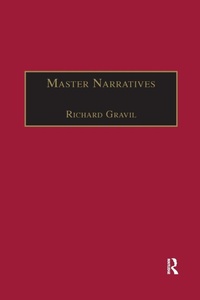
Master Narratives
Tellers and Telling in the English Novel
1st Edition
Published on 12. December 2019
Book
Paperback/Softback
224 pages
978-0-367-88824-4 (ISBN)
Description
Authors whose works are discussed in this collaborative book, covering a 'long' nineteenth century, include Sterne, Fielding, Scott, Austen, Mary Shelley, Emily BrontA<<, Gaskell, Dickens, George Eliot, Conrad, Woolf, and Lawrence. Most of the chapters focus on a single work, among them Tristram Shandy, Wuthering Heights, Bleak House, Middlemarch and Lord Jim, asking why, in the end, does this novel matter, and what does it invite us to 'see'. The contributors examine aspects of narrative technique which are crucial to interpretation, and which bring something new or distinctive into fiction. The introduction asks whether such experimentation may be driven by challenges to society's 'master narratives' - for instance, by a desire to circumvent the reader's ideological defences - and whether, in a radical model of canon-formation, such narrative innovation may be an aspect of canonicity.
More details
Series
Language
English
Place of publication
London
United Kingdom
Publishing group
Taylor & Francis Ltd
Target group
College/higher education
Dimensions
Height: 234 mm
Width: 156 mm
Thickness: 12 mm
Weight
348 gr
ISBN-13
978-0-367-88824-4 (9780367888244)
Copyright in bibliographic data and cover images is held by Nielsen Book Services Limited or by the publishers or by their respective licensors: all rights reserved.
Schweitzer Classification
Other editions
Additional editions
E-Book
03/2017
Routledge
€60.49
Available for download
E-Book
03/2017
Routledge
€60.49
Available for download
Book
04/2001
1st Edition
Routledge
€215.77
Shipment within 10-20 days
Person
Richard Gravil
Content
Contents: Introduction; How pleasant to meet Mr. Fielding: the narrator as hero in Tom Jones, W.B. Hutchings; 'Where then lies the difference?': the (ante)-postmodernity of Tristram Shandy, Jayne Lewis; Old Mortality: editor and narrator, Mary Wedd; Mathilda - who knew too much, Frederick Burwick; 'Perswasion' in Persuasion, Jane Stabler; Wuthering Heights as bifurcated novel, Frederick Burwick; Negotiating Mary Barton, Richard Gravil; Nell, Alice, Lizzie: three sisters amid the grotesque, Alan Shelston; The androgyny of Bleak House, Richard Gravil; Middlemarch and 'the Home Epic', Nicola Trott; The ghost of doubt: writing speech and language in Lord Jim, Gerard Barrett; Liking or disliking: Woolf, Conrad, Lawrence, Michael O'Neill; Index.