

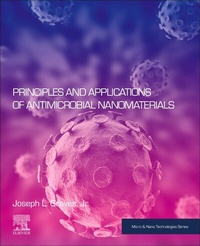
Principles and Applications of Antimicrobial Nanomaterials
Published on 25. August 2021
Book
Paperback/Softback
344 pages
978-0-12-822105-1 (ISBN)
Description
Principles and Applications of Antimicrobial Nanomaterials introduces the reader to the microbial world, antimicrobial nanomaterials, how microbial evolution works, and how knowledge of these areas can facilitate the development of sustainable antimicrobials.
Due to the widespread occurrence of multidrug-resistant microbes, there is an increasing interest in the use of novel nanostructured materials as antimicrobials. This book is designed to help researchers from fields such as materials science, nanoscience, and nanoengineering who are attempting to develop these antimicrobial materials.
Due to the widespread occurrence of multidrug-resistant microbes, there is an increasing interest in the use of novel nanostructured materials as antimicrobials. This book is designed to help researchers from fields such as materials science, nanoscience, and nanoengineering who are attempting to develop these antimicrobial materials.
More details
Series
Language
English
Place of publication
United States
Target group
Professional and scholarly
Illustrations
Approx. 250 illustrations (25 in full color)
Dimensions
Height: 235 mm
Width: 191 mm
Weight
730 gr
ISBN-13
978-0-12-822105-1 (9780128221051)
Copyright in bibliographic data and cover images is held by Nielsen Book Services Limited or by the publishers or by their respective licensors: all rights reserved.
Schweitzer Classification
Other editions
Additional editions
Joseph L. Graves Jr
Principles and Applications of Antimicrobial Nanomaterials
E-Book
08/2021
Elsevier
€175.00
Available for download
Person
Joseph L. Graves, Jr. is a professor of biological sciences in the Department of Biology, North Carolina A&T State University, Greensboro, NC, United States. His research focuses on the evolutionary genomics of adaptation, particularly as relevant to postponed aging and bacterial responses to nanomaterials.
Content
Section One: Nano and Microbes, A Brief History1. The Nanoscale: Definitions2. Characteristics of nanomaterials: Composition, coating, size, shape, surface properties, physical properties (inorganic, polymeric)3. Manufacture of nanomaterials - environmental exposure, toxicity, green synthesis, and sustainability4. Natural nanomaterials - microbial exposure5. MDR microbes and the "magic bullet." - metallic, metallic oxides - NPs
Section Two: Microbial Diversity6. Three Domains of Life - Structure and Function (Bacteria, Archaea, Eucarya)7. Bacteriophages and Viruses (not alive, but important)8. Microbial view of the periodic table9. Microbial defense
Section Three: Microbes and Why they Matter10. Food - Spoilage, Preservation, Industrial Microbiology11. Environment - Biogeochemical Cycles, Pollution12. Microbiomes - Naturally occurring and engineered13. Disease - Infectious (acute/chronic)14. Pharmaceuticals/Biotechnology - engineered proteins, vaccines, DNA vaccines
Section Four: Microbial Evolution15. Organic Evolution: Principles16. What Darwin Never Saw: How things differ between the microbial and macroscopic world. (Horizontal gene transfer, co-selection, persister cells)17. Classic studies of microbial evolution (antibiotic, metal)18. Evolution and nanomaterials (silver, copper, iron, gallium)19. Conclusion: Towards Sustainable Antimicrobial Nanomaterials
Section Two: Microbial Diversity6. Three Domains of Life - Structure and Function (Bacteria, Archaea, Eucarya)7. Bacteriophages and Viruses (not alive, but important)8. Microbial view of the periodic table9. Microbial defense
Section Three: Microbes and Why they Matter10. Food - Spoilage, Preservation, Industrial Microbiology11. Environment - Biogeochemical Cycles, Pollution12. Microbiomes - Naturally occurring and engineered13. Disease - Infectious (acute/chronic)14. Pharmaceuticals/Biotechnology - engineered proteins, vaccines, DNA vaccines
Section Four: Microbial Evolution15. Organic Evolution: Principles16. What Darwin Never Saw: How things differ between the microbial and macroscopic world. (Horizontal gene transfer, co-selection, persister cells)17. Classic studies of microbial evolution (antibiotic, metal)18. Evolution and nanomaterials (silver, copper, iron, gallium)19. Conclusion: Towards Sustainable Antimicrobial Nanomaterials