

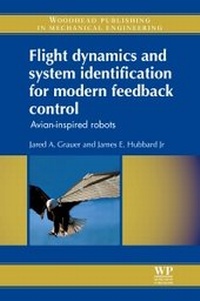
Flight Dynamics and System Identification for Modern Feedback Control
Avian-Inspired Robots
Published on 31. August 2013
Book
Hardback
160 pages
978-0-85709-466-7 (ISBN)
Description
Unmanned air vehicles are becoming increasingly popular alternatives for private applications which include, but are not limited to, fire fighting, search and rescue, atmospheric data collection, and crop surveys, to name a few. Among these vehicles are avian-inspired, flapping-wing designs, which are safe to operate near humans and are required to carry payloads while achieving manoeuverability and agility in low speed flight. Conventional methods and tools fall short of achieving the desired performance metrics and requirements of such craft. Flight dynamics and system identification for modern feedback control provides an in-depth study of the difficulties associated with achieving controlled performance in flapping-wing, avian-inspired flight, and a new model paradigm is derived using analytical and experimental methods, with which a controls designer may then apply familiar tools. This title consists of eight chapters and covers flapping-wing aircraft and flight dynamics, before looking at nonlinear, multibody modelling as well as flight testing and instrumentation. Later chapters examine system identification from flight test data, feedback control and linearization.
Reviews / Votes
"...very clearly written and is quite readable. The authors are clearly leading experts in the field...strongly recommended to readers interested in the subject." --The Aeronautical Journal, February 2015"Aerospace engineers Grauer...and Hubbard...describe an ornithopter they designed, built, and tested. An ornithopter flies by flapping wings like a bird. They cover ornithopter test platform characterizations, rigid multi-body vehicle dynamics, system identification of aerodynamic models, and simulation results." --ProtoView.com, February 2014
More details
Language
English
Place of publication
Cambridge
United Kingdom
Publishing group
Elsevier Science & Technology
Target group
Professional and scholarly
Dimensions
Height: 234 mm
Width: 156 mm
Weight
400 gr
ISBN-13
978-0-85709-466-7 (9780857094667)
Copyright in bibliographic data and cover images is held by Nielsen Book Services Limited or by the publishers or by their respective licensors: all rights reserved.
Schweitzer Classification
Other editions
Additional editions
Jared A. Grauer | James E. Hubbard Jr.
Flight Dynamics and System Identification for Modern Feedback Control
Avian-Inspired Robots
E-Book
08/2013
Woodhead Publishing
€149.00
Available for download
Persons
Jared A. Grauer is a research aerospace engineer with the National Aeronautics and Space Administration at Langley Research Center. Prior to this he earned a PhD from the University of Maryland in Aerospace Engineering. His research is in system identification, feedback control, and unmanned air vehicle systems. Dr. James E. Hubbard, Jr. is currently the Glenn L. Martin Institute Professor at the University of Maryland and resident in Hampton, Virginia. He has an engineering career that is distinguished by more than four decades of scholarship and innovation. He began his career in 1971 as an engineering officer in the U.S. Merchant Marine serving in Vietnam. At the age of 19 qualified for and received an Unlimited Horsepower, steam, and diesel engine Marine Engineering operator's license from the U.S. Coast Guard and was one the youngest to get such an honor. He was also one of only a handful of African American Marine Engineers in the entire U.S. Merchant fleet. He also holds a B.S., M.S. and Phd. from the at the Massachusetts Institute of Technology and during his time there he distinguished himself by receiving the Goodwin Medal for "Conspicuously Effective Teaching? and The Steward Award for Outstanding Community Service. His scholarship was also recognized as a Scott Foundation Fellow and a Vertical Flight Foundation Fellow. His work in the area of Adaptive Structures has received more than 2500 citations representing an average 100 citations a year for 25 years. He is internationally known and respected as a founding father of the field of Adaptive Structures and his original experiments in this area have become icons of the field and can be found in laboratories, classrooms and corporations around the globe. He has cofounded 3 companies and holds more than 2 dozen patents in the field of Adaptive Structures. He has received the "Key to the City? of his hometown of Danville, Virginia for lifetime achievement. He has also received the Lifetime Achievement Award of the SPIE. He has written several books in the field and more authored than 200 technical publications in his chosen field. He has also been recognized by his African American peers as the 2002 receipt of the Black Engineer of the Year "President's Award?. His professional affiliations include, Senior Lifetime Member and Fellow of the AIAA, Fellow of the American Society of Mechanical Engineers, and Senior Member of the SPIE. Member of the National Academy of Engineering and the Virginia Academy of Science, Engineering, and Medicine.
Content
Dedication
List of figures
List of tables
Nomenclature
Preface
About the authors
Chapter 1: Introduction
Abstract:
1.1 Background and motivation
1.2 Bio-inspired flapping wing aircraft
1.3 Flapping-wing literature review
1.4 Scope and contributions of current research
Chapter 2: Ornithopter test platform characterizations
Abstract:
2.1 Mathematical representation of an aircraft
2.2 Ornithopter aircraft description
2.3 Measurements from flight data
2.4 Configuration-dependent mass distribution
2.5 Quasi-hover aerodynamics
2.6 Implications for flight dynamics modeling
2.7 Chapter summary
Chapter 3: Rigid multibody vehicle dynamics
Abstract:
3.1 Model configuration
3.2 Kinematic equations of motion
3.3 Dynamic equations of motion
3.4 Chapter summary
Chapter 4: System identification of aerodynamic models
Abstract:
4.1 System identification method
4.2 Tail aerodynamics
4.3 Wing aerodynamics
4.4 Chapter summary
Chapter 5: Simulation results
Abstract:
5.1 Software simulation architecture
5.2 Determining trim solutions
5.3 Numerical linearization about straight and level mean flight
5.4 Modeling implications for control
5.5 Chapter summary
Chapter 6: Concluding remarks
Abstract:
6.1 Summary of work
6.2 Summary of modeling assumptions
6.3 Summary of original contributions
6.4 Recommendations for future research
Appendix A: Field calibration of inertial measurement units
Appendix B: Actuator dynamics system identification
Appendix C: Equations of motion for single-body flight vehicles
Appendix D: Linearization of a conventional aircraft model
References
Index
List of figures
List of tables
Nomenclature
Preface
About the authors
Chapter 1: Introduction
Abstract:
1.1 Background and motivation
1.2 Bio-inspired flapping wing aircraft
1.3 Flapping-wing literature review
1.4 Scope and contributions of current research
Chapter 2: Ornithopter test platform characterizations
Abstract:
2.1 Mathematical representation of an aircraft
2.2 Ornithopter aircraft description
2.3 Measurements from flight data
2.4 Configuration-dependent mass distribution
2.5 Quasi-hover aerodynamics
2.6 Implications for flight dynamics modeling
2.7 Chapter summary
Chapter 3: Rigid multibody vehicle dynamics
Abstract:
3.1 Model configuration
3.2 Kinematic equations of motion
3.3 Dynamic equations of motion
3.4 Chapter summary
Chapter 4: System identification of aerodynamic models
Abstract:
4.1 System identification method
4.2 Tail aerodynamics
4.3 Wing aerodynamics
4.4 Chapter summary
Chapter 5: Simulation results
Abstract:
5.1 Software simulation architecture
5.2 Determining trim solutions
5.3 Numerical linearization about straight and level mean flight
5.4 Modeling implications for control
5.5 Chapter summary
Chapter 6: Concluding remarks
Abstract:
6.1 Summary of work
6.2 Summary of modeling assumptions
6.3 Summary of original contributions
6.4 Recommendations for future research
Appendix A: Field calibration of inertial measurement units
Appendix B: Actuator dynamics system identification
Appendix C: Equations of motion for single-body flight vehicles
Appendix D: Linearization of a conventional aircraft model
References
Index