

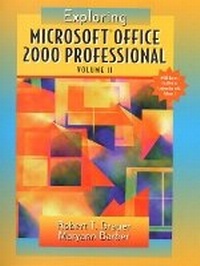
Exploring Microsoft Office Professional 2000, Volume II
Published on 27. September 1999
Book
Spiral bound
848 pages
978-0-13-011100-5 (ISBN)
Description
For Introductory Computer courses in Microsoft Office 2000 or courses in Computer Concepts with a lab component for Microsoft Office 2000 applications.
Master the How and Why of Office 2000! Students master the "How and Why" of performing tasks in Office and gain a greater understanding of how to use the individual applications together to solve business problems.
Master the How and Why of Office 2000! Students master the "How and Why" of performing tasks in Office and gain a greater understanding of how to use the individual applications together to solve business problems.
More details
Language
English
Place of publication
United States
Publishing group
Pearson Education (US)
Target group
Professional and scholarly
Dimensions
Height: 278 mm
Width: 235 mm
Thickness: 36 mm
Weight
1653 gr
ISBN-13
978-0-13-011100-5 (9780130111005)
Copyright in bibliographic data and cover images is held by Nielsen Book Services Limited or by the publishers or by their respective licensors: all rights reserved.
Schweitzer Classification
Other editions
New editions
Robert T. Grauer | Maryann Barber
Exploring Microsoft Office XP Professional, Vol. 2
Book
09/2001
Pearson
€34.65
Article exhausted; check for reprint
Content
MICROSOFT WORD 2000.
5. Desktop Publishing: Creating a Newsletter.
6. Creating a Home Page: Introduction to HTML.
7. The Expert User: Work Groups, Master Documents, and Macros.
Appendix A: Toolbars.
Appendix B: Data Mapping.
Appendix C: Solver.
MICROSOFT EXCEL 2000.
5. List and Data Management: Converting Data to Information.
6. Consolidating Data: 3-D Workbooks and File Linking.
7. Automating Repetitive Tasks: Macros and Visual Basic.
8. The Expert User: Workgroups, Auditing, and Templates.
Appendix A: Toolbars.
Appendix B: Data Mapping.
Appendix C: Solver.
MICROSOFT ACCESS 2000.
4. Proficiency: Relational Databases, External Charts, and the Switchboard.
5. One-to-Many Relationships: Subforms and Multiple Table Queries.
6. Many-to-Many Relationships: A More Complex System.
7. Building Applications: The Switchboard Manager, Macros and Prototyping.
8. Creating More Powerful Applications: Introduction to VBA.
Appendix A: Toolbars.
Appendix B: Database Design-Getting the Most from Microsoft Access.
Appendix C: Combining an Access Database with a Word Form Letter.
Appendix D: A Semester Project.
MICROSOFT POWERPOINT 2000.
2. Gaining Proficiency: Refining and Delivering a Presentation.
3. Adding Impact: The Web and Other Resources.
Appendix A: Toolbars.
Appendix B: Introduction to Multimedia.
5. Desktop Publishing: Creating a Newsletter.
6. Creating a Home Page: Introduction to HTML.
7. The Expert User: Work Groups, Master Documents, and Macros.
Appendix A: Toolbars.
Appendix B: Data Mapping.
Appendix C: Solver.
MICROSOFT EXCEL 2000.
5. List and Data Management: Converting Data to Information.
6. Consolidating Data: 3-D Workbooks and File Linking.
7. Automating Repetitive Tasks: Macros and Visual Basic.
8. The Expert User: Workgroups, Auditing, and Templates.
Appendix A: Toolbars.
Appendix B: Data Mapping.
Appendix C: Solver.
MICROSOFT ACCESS 2000.
4. Proficiency: Relational Databases, External Charts, and the Switchboard.
5. One-to-Many Relationships: Subforms and Multiple Table Queries.
6. Many-to-Many Relationships: A More Complex System.
7. Building Applications: The Switchboard Manager, Macros and Prototyping.
8. Creating More Powerful Applications: Introduction to VBA.
Appendix A: Toolbars.
Appendix B: Database Design-Getting the Most from Microsoft Access.
Appendix C: Combining an Access Database with a Word Form Letter.
Appendix D: A Semester Project.
MICROSOFT POWERPOINT 2000.
2. Gaining Proficiency: Refining and Delivering a Presentation.
3. Adding Impact: The Web and Other Resources.
Appendix A: Toolbars.
Appendix B: Introduction to Multimedia.