

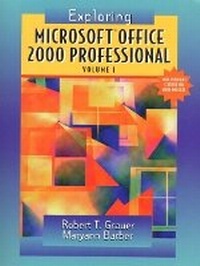
Exploring Microsoft Office Professional 2000, Volume I
Published on 16. June 1999
Book
Spiral bound
848 pages
978-0-13-011109-8 (ISBN)
Description
For any course teaching application software using Microsoft Office 2000 applications. This book will appeal to students in a variety of disciplines including liberal arts, business, and the sciences.
All books in this series offer consistent presentation-common design, pedagogy, and writing style. Concepts as well as key-strokes are stressed. Hands-on exercises in every lesson provide just the right amount of practice time. This best-selling author team's hands-on approach and conceptual framework helps students master important concepts, as well as the features of the powerful new Office 2000 applications.
All books in this series offer consistent presentation-common design, pedagogy, and writing style. Concepts as well as key-strokes are stressed. Hands-on exercises in every lesson provide just the right amount of practice time. This best-selling author team's hands-on approach and conceptual framework helps students master important concepts, as well as the features of the powerful new Office 2000 applications.
More details
Language
English
Place of publication
United States
Publishing group
Pearson Education (US)
Target group
Professional and scholarly
Dimensions
Width: 280 mm
Thickness: 40 mm
Weight
1593 gr
ISBN-13
978-0-13-011109-8 (9780130111098)
Copyright in bibliographic data and cover images is held by Nielsen Book Services Limited or by the publishers or by their respective licensors: all rights reserved.
Schweitzer Classification
Other editions
New editions
Robert T. Grauer | Maryann Barber
Exploring Microsoft Office 2000, Volume I Revised
International Edition
Book
01/2003
Pearson
€40.84
Article is exhausted; no reprint
Robert T. Grauer | Maryann Barber
Exploring Microsoft Office XP Professional, Vol. 1
Book
08/2001
Pearson
€34.65
Article exhausted; check for reprint
Content
Essentials of Windows 95/98.
I. MICROSOFT WORD 2000.
1. Introduction: What Will Word Processing Do For Me?
2. Gaining Proficiency: Editing and Formatting.
3. Enhancing a Document: The Web and Other Resources.
4. Advanced Features: Outlines, Tables, Styles, and Sections.
II. MICROSOFT EXCEL 2000.
1. Introduction to Microsoft Excel: What Is a Spreadsheet?
2. Gaining Proficiency: Copying, Formatting, and Isolating Assumptions.
3. Spreadsheets in Decision Making: What If?
4. Graphs and Charts: Delivering a Message.
III. MICROSOFT ACCESS 2000.
1. Introduction to Microsoft Access: What Is a Database?
2. Tables and Forms: Design, Properties, Views, and Wizards.
3. Information from the Database: Reports and Queries.
IV. MICROSOFT POWERPOINT 2000.
1. Introduction to PowerPoint: Presentations Made Easy.
V. INTERNET EXPLORER 5.0.
1. Welcome to Cyberspace: the Internet and World Wide Web.
2. Search Engines: Finding Information on the Web.
Appendix A: How the Internet Works (TCP/IP).
Appendix B. Hot Sites on the Internet.
VI. ESSENTIAL COMPUTING CONCEPTS.
I. MICROSOFT WORD 2000.
1. Introduction: What Will Word Processing Do For Me?
2. Gaining Proficiency: Editing and Formatting.
3. Enhancing a Document: The Web and Other Resources.
4. Advanced Features: Outlines, Tables, Styles, and Sections.
II. MICROSOFT EXCEL 2000.
1. Introduction to Microsoft Excel: What Is a Spreadsheet?
2. Gaining Proficiency: Copying, Formatting, and Isolating Assumptions.
3. Spreadsheets in Decision Making: What If?
4. Graphs and Charts: Delivering a Message.
III. MICROSOFT ACCESS 2000.
1. Introduction to Microsoft Access: What Is a Database?
2. Tables and Forms: Design, Properties, Views, and Wizards.
3. Information from the Database: Reports and Queries.
IV. MICROSOFT POWERPOINT 2000.
1. Introduction to PowerPoint: Presentations Made Easy.
V. INTERNET EXPLORER 5.0.
1. Welcome to Cyberspace: the Internet and World Wide Web.
2. Search Engines: Finding Information on the Web.
Appendix A: How the Internet Works (TCP/IP).
Appendix B. Hot Sites on the Internet.
VI. ESSENTIAL COMPUTING CONCEPTS.