

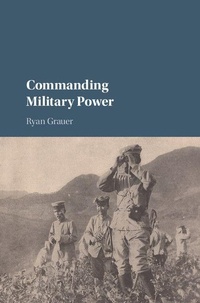
Commanding Military Power
Organizing for Victory and Defeat on the Battlefield
Published on 28. July 2016
Book
Hardback
280 pages
978-1-107-15821-4 (ISBN)
Description
Commanding Military Power offers a new explanation of why some armed forces are stronger than others. Ryan Grauer advances a 'command structure theory' which combines insights from organization theory, international relations, and security studies literatures to provide a unique perspective on military power. Specifically, armed forces organized to facilitate swift and accurate perception of and response to battlefield developments will cope better with war's inherent uncertainty, use resources effectively, and, quite often, win. Case studies of battles from the Russo-Japanese War, Chinese Civil War and Korean War, based on new archival research, underscore the argument, showing that even smaller and materially weaker militaries can fight effectively against and defeat larger and better endowed adversaries when they are organizationally prepared to manage uncertainty. That organization often matters more than numbers and specific tools of war has crucial implications for both contemporary and future thinking about and efforts to improve martial strength.
More details
Language
English
Place of publication
Cambridge
United Kingdom
Target group
Professional and scholarly
Dimensions
Height: 235 mm
Width: 157 mm
Thickness: 20 mm
Weight
560 gr
ISBN-13
978-1-107-15821-4 (9781107158214)
Copyright in bibliographic data and cover images is held by Nielsen Book Services Limited or by the publishers or by their respective licensors: all rights reserved.
Schweitzer Classification
Other editions
Additional editions
E-Book
11/2016
Cambridge University Press
€36.99
Available for download
Book
07/2016
Cambridge University Press
€49.00
Shipment within 15-20 days
E-Book
07/2016
Cambridge University Press
€24.49
Available for download
Person
Ryan Grauer is Assistant Professor of International Affairs at the Graduate School of Public and International Affairs, University of Pittsburgh. His research on military power, surrender in war, and military diffusion has been published in Security Studies and World Politics. He has been awarded funding from the Smith Richardson Foundation, the Christopher Browne Center for International Politics, and the Matthew B. Ridgway Center for International Security Studies.
Content
1. Introduction; 2. Commanding military power; 3. Liaoyang; 4. Huai-Hai campaign; 5. The 5th phase offensive; 6. The 3rd phase offensive; 7. Conclusion.