

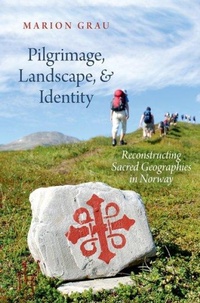
Pilgrimage, Landscape, and Identity
Reconstucting Sacred Geographies in Norway
Published on 22. October 2021
Book
Hardback
258 pages
978-0-19-759863-4 (ISBN)
Description
Pilgrimage, Landscape, and Identity: Reconstructing Sacred Geographies in Norway explores the ritual geography of a pilgrimage system that arose around medieval saints in Norway, a country now being transformed by petroleum riches, neoliberalism, migration and global warming. What it means to be Norwegian and Christian in this changing context is constantly being renegotiated. The contemporary revival of pilgrimage to the burial site of St. Olav at Nidaros Cathedral in Trondheim is one site where this negotiation takes place. St. Olav played a major role in the unification of regions of Norway into a nation united by Christian law and faith, though most contemporary pilgrims have only a passing interest in the historical background of the pilgrimage. The pilgrimage network comprises a wide variety of participants: individuals, casual groups, guided group pilgrimages, activist pilgrims raising awareness for causes such as climate change and hospice services, as well as increasing numbers of local and foreign pilgrims of various ages, government officials, pilgrimage activists, and pilgrimage priests supplied by the Church of Norway (Lutheran). Part of the study focuses on the Olavsfest, a cultural and music festival that engages the heritage of St. Olav and the Church of Norway through theater, music, lectures, and discussions, and theological and interreligious conversations. This festival offers an opportunity for creative and critical engagement with a difficult historical figure and his contested, violent heritage and constitutes one of the ways in which this pilgrimage network represents a critical Protestant tradition engaging a legacy through ritual creativity.
This study maps how pilgrims, hosts, church officials, and government officials participate in reshaping narratives of landscape, sacrality, and pilgrimage as a symbol of life journey, nation, identity, Christianity, and Protestant reflections on the durability of medieval Catholic saints.
This study maps how pilgrims, hosts, church officials, and government officials participate in reshaping narratives of landscape, sacrality, and pilgrimage as a symbol of life journey, nation, identity, Christianity, and Protestant reflections on the durability of medieval Catholic saints.
Reviews / Votes
Pilgrimage, Landscape, and Identity provides a welcome international perspective on pilgrimage in Norway, one of the few monographs on this topic published in English. Grau's circumambulation, combined with attention to international geopolitical and social issues, is commendable in its perspective on economic and ecological factors, as well as for including the voices of minorities in the discussions about the developments of pilgrimage networks. * Hannah Kristine Lunde, Folklore * In this impeccably researched and engagingly-written book, Marion Grau introduces readers to a Norwegian 'pilgrimage network' and its ritualizations of text, landscape, practices, and narratives. Grau brings an ecumenical perspective and a cross-disciplinary approach to bear on this rich study of reconstructed medieval pilgrimages, both at their inceptions and today as they continue to play a formative role in personal, national, and religious identity. Grau is an academic, pilgrim, and guide as she maps these paths for the reader in this important contribution to the ever-growing field of pilgrimage studies. * Kathryn R. Barush, Associate Professor and Thomas E. Bertelsen Jr. Chair of Art History and Religion, Graduate Theological Union, Berkeley / Jesuit School of Theology of Santa Clara University * There has been a remarkable revival of pilgrimage shrines and routes in post-Reformation countries across Northern Europe. Marion Grau has made an impressive contribution to the growing, inter-disciplinary study of this revival. She guides us gently along the routes to the St. Olav shrine in Trondheim and sets this particular example within the wider context of a changing nation. * John Eade, Professor of Sociology and Anthropology, University of Roehampton, London * Interweaving 'circumambulatory field work,' theological reflection, and historical analysis, Grau has produced a richly textured tapestry of various narratives and vividly present landscapes and bodies. This is an impressive exploration of important issues concerning migration, nationalism, sacred and secular rituals, and climate change within the context of a Norwegian pilgrimage. * Sarah M. Pike, author of For the Wild: Ritual and Commitment in Radical Eco-Activism * It is indeed a fine and novel study of pilgrimage in Norway, with interesting nuances and rich source materials. The book is written in an engaging language free of theological jargon, and it is both thought-provoking and interesting. It's well worth the read. * Peder AnkerGallatin, Journal for the Study of Religion, Nature and Culture *More details
Series
Language
English
Place of publication
New York
United States
Target group
College/higher education
Product notice
sewn/stitched
Cloth over boards
Dimensions
Height: 243 mm
Width: 164 mm
Thickness: 25 mm
Weight
498 gr
ISBN-13
978-0-19-759863-4 (9780197598634)
Copyright in bibliographic data and cover images is held by Nielsen Book Services Limited or by the publishers or by their respective licensors: all rights reserved.
Schweitzer Classification
Other editions
Additional editions
E-Book
07/2021
OUP eBook
€43.49
Available for download
E-Book
07/2021
OUP eBook
€43.49
Available for download
Person
Marion Grau is Professor of Systematic Theology, Ecumenism and Missiology at MF Norwegian School of Theology, Religion, and Society in Oslo, Norway. Her teaching interests are in constructive theology and her current research projects include the redevelopment of pilgrimage and the reshaping of identity in Norway and a Theology of petroleum economies and climate change in the Northern hemisphere. She is the author of Refiguring Theological Hermeneutics: Hermes, Trickster, Fool, Rethinking Mission in the Postcolony: Salvation, Society, and Subversion, and Of Divine Economy: Refinancing Redemption.
Content
Introduction Chapter 1
Reconstructing Sacred Geographies: Narrating Routes and Landscapes Chapter 2
Vikings, Saints and Pilgrimage Chapter 3
Mapping The Pilgrimage Network Chapter 4
Encountering Pilgrims Chapter 5
Ocean Pilgrimage and Ocean Plastics: Coastal Activism and the Reopening of the Marine Pilgrim Route Chapter 6
Cathedral and Town: Movable Feasts and Adaptable Spaces Chapter 7
Reconstructing Rituls: Pilgrimage and Sainthood in Contemporary Norway Epilogue
Works Cited
Notes
Reconstructing Sacred Geographies: Narrating Routes and Landscapes Chapter 2
Vikings, Saints and Pilgrimage Chapter 3
Mapping The Pilgrimage Network Chapter 4
Encountering Pilgrims Chapter 5
Ocean Pilgrimage and Ocean Plastics: Coastal Activism and the Reopening of the Marine Pilgrim Route Chapter 6
Cathedral and Town: Movable Feasts and Adaptable Spaces Chapter 7
Reconstructing Rituls: Pilgrimage and Sainthood in Contemporary Norway Epilogue
Works Cited
Notes